9 Common Scams in Egypt (and How to Avoid Them)
Egypt is an unforgettable travel destination. We’re talking ancient wonders (Hello Pyramids of Giza!), historic cities, and a strong culture that draws millions of visitors every year. But like many popular tourist destinations around the world, Egypt also has scams that specifically target visitors who may be unfamiliar with local customs, pricing norms, or how tourism works on the ground.
This guide is designed to inform you, not intimidate you. Most scams in Egypt are non-violent, opportunistic, and avoidable once you know what to expect. Understanding how these scams work, and where you’re most likely to encounter them,will help you travel with confidence and enjoy your trip with far less stress.
Let’s break down of the most common scams tourists encounter in Egypt, including how they work, where they happen, common variations, and exactly how to avoid them.
Disclosure: Some of the links below may be affiliate links. At no additional cost to you, I may earn a small commission if you make a purchase.
1. The “It’s Closed Today” Scam
This is one of the most common tourist scams in Egypt, especially in Cairo, Giza, Luxor, and Aswan. It typically happens just outside major attractions such as the Pyramids of Giza, the Egyptian Museum, or famous temples.
A stranger, often presenting themselves as an official, security guard, or licensed guide, will approach you and claim the site is closed due to prayer time, a national holiday, a private event, or renovations. They may sound convincing and even express sympathy for your bad luck.
The scam works because it creates urgency and confusion. Once you believe the attraction is closed, the scammer conveniently offers an alternative plan: another site, a special viewpoint, a shop, or a cultural experience. These detours almost always lead to commission-based stops like souvenir shops, papyrus galleries, or perfume stores.
How to Avoid It
- Never trust unsolicited information outside major attractions.
- Walk directly to the official entrance and check posted hours.
- Ask staff in uniform or verify opening times through your hotel.
2. Camel and Horse Ride Scams at the Pyramids
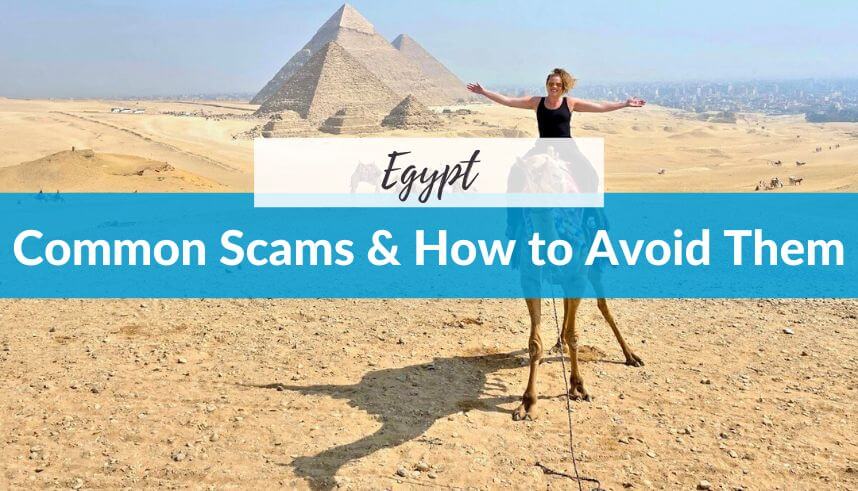
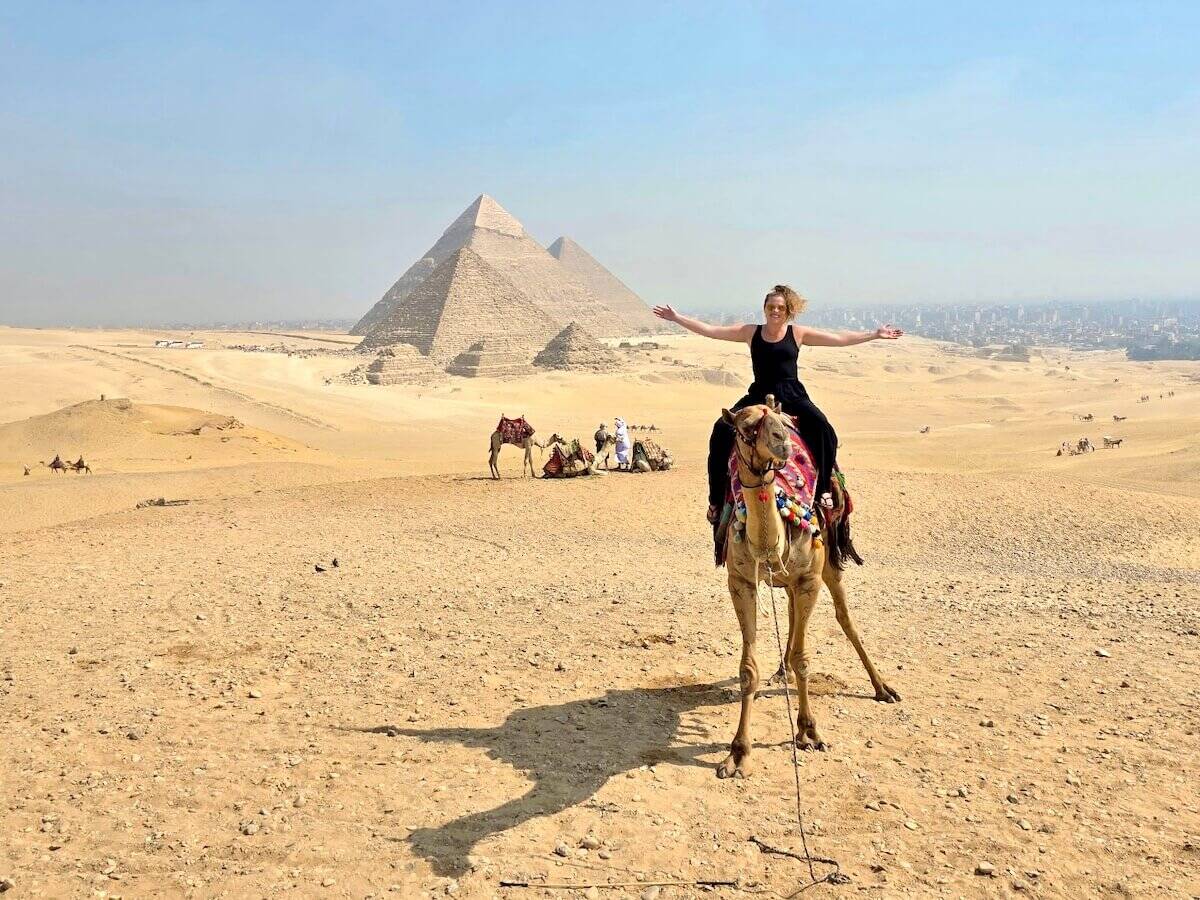
Camel and horse ride scams are extremely common at the Pyramids of Giza and other historic sites. Handlers often quote a low price to get you interested, knowing that once you’re mounted, you’re in a vulnerable position.
After the ride, they may claim the original price was per minute, only covered part of the ride, or didn’t include getting off the animal. Some tourists report being asked for extra money just to be helped down.
This scam works because many visitors feel uncomfortable arguing while elevated on an animal or surrounded by handlers.
How to Avoid It
- Agree on the total price, including the return and dismount, before mounting.
- Clarify the price in Egyptian pounds.
- Consider booking through an official tour or licensed guide.
Having visited twice before and endured all the touts and scam artists, we hired a guide from our hotel for our visit to the Pyramids in 2025. That eliminated the hassle entirely. She negotiated through official channels and handled payment on our behalf.

3. The “Helpful Stranger” Scam
One of the most subtle scams in Egypt involves friendly locals offering unsolicited help. This often includes giving directions, explaining a site, escorting you somewhere, carrying your bag, taking your picture, or assisting with tickets. The interaction feels harmless and genuine, until the person demands a tip, sometimes aggressively, and often far higher than expected.
This scam commonly occurs near the airport, metro stations, busy streets, historic sites, and tourist-heavy areas in Cairo. You could say its everywhere…
How to Avoid It
- Politely decline help unless you specifically ask for it.
- Use GPS or maps on your phone.
- If you need assistance, ask someone in uniform or step into a shop or café.
4. Taxi Scams in Egypt (Broken Meters & Inflated Fares)
Taxi scams are among the most frequent frustrations for tourists in Egypt, and admittedly I’ve faced them each and every trip to the country. Drivers may claim the meter is broken, refuse to use it, quote prices in foreign currency, or take unnecessarily long routes.
In some areas, particularly resort towns like Hurghada, even rideshare drivers from Uber, Careem, and InDrive may call after accepting a trip to renegotiate the fare or try to charge you more once you are in the car.
The confusion around currency and local pricing makes this scam particularly effective for visitors.
How to Avoid It
- Use Uber or Careem whenever possible, and stick to the quoted rate.
- Cancel rides if drivers demand higher prices.
- Agree on a price before entering a street taxi and carry exact change.
5. Fake Tour Guides
Fake tour guides are a common scam near Egypt’s most visited attractions, including the Pyramids of Giza, the Egyptian Museum, Luxor’s Karnak Temple, Valley of the Kings, and popular mosque or church complexes.
These individuals often approach confidently, speaking excellent English and sharing impressive historical facts to establish credibility. Some may wear lanyards, badges, or carry notebooks to appear official, while others claim they are “waiting for clients” or are former licensed guides.
The scam usually unfolds in one of two ways: either they begin guiding you without clear consent and demand payment at the end, or they quote a vague price upfront and later insist it was per person, per hour, or only for a portion of the site. In some cases, refusing to pay can lead to uncomfortable confrontations.
This scam works particularly well because many visitors are not aware they these people are not licensed guides or that they have implied consent and payment for a guide that they didn’t plan to hire.
How to Avoid It
- Only book guides through reputable tour companies, hotels, or trusted online platforms like Viator and GetYourGuide.
- Ask to see an official government-issued tour guide license.
- If someone starts guiding you without permission, firmly say “La shukran” and walk away.
6. Papyrus Shop Scams
Papyrus shop scams are among the most polished and convincing scams in Egypt. They often begin when a driver, guide, or “helpful local” insists on taking you to an authentic or government-approved papyrus institute.
Once inside, you’ll be seated and given a detailed demonstration about how real papyrus is made, including soaking, pressing, and painting techniques. While informative, this demonstration is part of the sales strategy. Afterward, prices are revealed, often shockingly high, and pressure to buy increases.
Some shops sell fake papyrus made from banana leaves or palm fiber, while others sell genuine papyrus but at extremely inflated prices. They’re trying to make you feel obligated to purchase something after spending so much time there.
How to Avoid It
- Don’t follow strangers or drivers to shops you didn’t research yourself.
- Know that many “factory” or “institute” claims are marketing tactics.
- If authenticity matters, research government-endorsed or well-reviewed shops in advance.
- Don’t feel obligated to buy just because you watched a demonstration.
Personally, I think Papyrus art makes a great affordable and packable souvenir. My first trip to Egypt I purchased too many… that being said the quality and prices vary greatly. Always negotiate and walk away if the price feels too high. I recommend shopping at a few stores to see what prices should be before purchasing to avoid feeling like you overpaid later.
7. Perfume and Spice Shop Pressure Sales
Perfume and spice shop scams are often disguised as cultural experiences. You are invited inside to smell essential oils, spices, or teas while being told stories about ancient Egyptian beauty rituals or medicinal uses. Demonstrations can last 20–40 minutes and are designed to build emotional investment before prices are mentioned. (Not dissimilar to the Papyrus scam)
While some products may be genuine, prices are often far above market value, and claims about purity or healing benefits can be exaggerated. These stops are frequently commission-based for drivers and tour guides, which explains the aggressive sales tactics.
How to Avoid It
- Be skeptical of shops presented as “the best in Egypt” by someone you just met.
- Set a clear boundary or time limit before entering.
- Say “La shukran” firmly and repeatedly if needed.
- You are never obligated to buy, regardless of how much time you spent inside.
8. “Free” Gift Scams
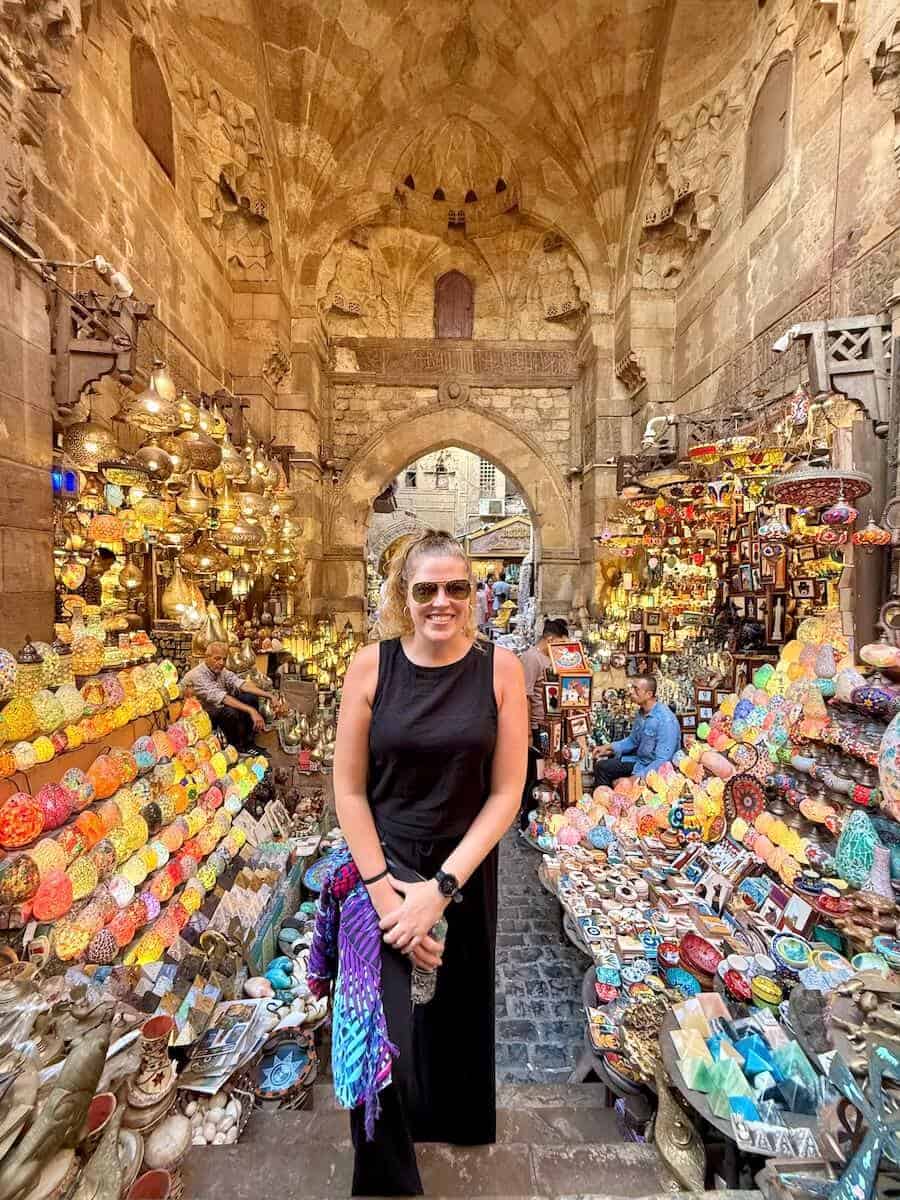
The “free gift” scam is common in busy markets, near temples, and in tourist-heavy streets. A vendor may casually place a bracelet on your wrist, hand you a small souvenir, or offer a papyrus or trinket as a “welcome gift.” Once you accept, or even hold the item, the tone changes quickly, and payment is demanded.
This scam relies heavily on social pressure and politeness, especially for travelers who don’t want to seem rude or cause a scene. In group settings, vendors may become louder or draw attention to pressure you into paying.
How to Avoid It
- Don’t accept anything you haven’t agreed to buy.
- Immediately hand the item back (or set it down if they won’t take it) and walk away.
- Avoid engaging in long conversations once an item is offered.
9. Fake Tourist Police
Although rare, fake tourist police scams can be intimidating because they exploit fear of authority. Scammers posing as tourist police may approach travelers near major attractions or transport hubs, like outside the airport, and claim they need to inspect passports, visas, or bags. They may say there is a problem with your documents or accuse you of a minor violation.
Once they have your attention, or your documents, they demand a bribe to “resolve” the issue. In most cases, they are not real officers and rely on tourists panicking or complying quickly.
How to Avoid It
- Ask to see official identification and badges.
- Never hand over your passport unless absolutely necessary.
- Move toward a crowded area or an official police station.
- Contact your hotel or embassy if you feel uncomfortable.
Mindset & Cultural Context
Having been to Egypt multiple times, you could say I like it, but it’s not without its challenges. Understanding Egypt’s cultural and economic context can completely change how you experience the country, and how you interpret many interactions that feel uncomfortable to those of us from a completely different background.
While Egypt is rich in history, hospitality, and tradition, it is also a country where the average Egyptian earns very little per year compared to what most international visitors spend on a single vacation. Let’s take a look at that to help you gain some understanding.
Egypt Income & Wage Statistics
When I first visited Egypt in 2006, 1 United States Dollar = 7 Egyptian Pounds. When I visited in 2025, the Egyptian Pound had dropped in value to 1 USD = 48 Egyptian Pounds. That’s almost a 7x change!
1. Average Salary in Egypt
As of 2025, the average salary in Egypt is estimated at around 9,200 Egyptian pounds per month (~USD $192 per month). Source: Zimyo
2. Median Salary
The median salary in Egypt (the midpoint of earners) is approximately 7,840 EGP per month (~USD $163/month). Source: Zimyo
3. Minimum Wage Context
Egypt’s official minimum wage for public sector workers rose significantly in 2025 to 7,000 EGP per month (~ USD $145/month), aligning with private sector rates due to economic pressures and inflation in the country. Source: Reuters
4. GDP Per Capita (Income Proxy)
Egypt’s GDP per capita, a common indicator of average economic output per person, is about $3,338 USD per year or $278/month, significantly lower than many Western countries. Source: Georank
What This Means in Context
When you compare these figures to what you might budget to travel to Egypt, you can suddenly understand the hustle and why many locals rely on tourism-related jobs, tips, and commissions to support themselves.
A typical tourist can spend in a single day what some Egyptians might earn in a month or more of work. Using exchange rates and daily wage norms, even a small souvenir purchase or tip can represent a meaningful amount to a local vendor or worker.
This context doesn’t excuse scams or aggressive sales behavior, but it does help explain why they occur frequently in tourist-heavy areas and why negotiation and cultural awareness are so important when traveling in Egypt.
How to Make the Most of Your Trip to Egypt
While knowing what scams to look out for is super helpful, there are a few mindset shifts that can also improve your experience in Egypt.
- Negotiation is cultural, not confrontational. In bazaars, souvenir shops, papyrus stores, and markets, high initial prices are normal and expected. Bargaining is part of the process and is often viewed as a friendly back-and-forth rather than a conflict. Try to enjoy it and smile throughout. It is meant to be a win-win for both of you.
- Polite firmness is respected. A confident “La shukran” (no thank you), paired with continuing to walk, is often far more effective than long explanations or apologies. Trust me, you’ll get better at this after the 20th person tries to stop you.
- Not every uncomfortable interaction is a scam. Many locals offering services are simply trying to earn a living, even if their approach feels pushy by Western standards. Unfortunately, it’s hard to know the difference. Because of that, I recommend following the above tips for Egypt.
- Boundaries are not rude. You are never obligated to accept help, buy something, tip for unsolicited services, or continue a conversation that makes you uncomfortable. That being said, if you have agreed to pay for something, please uphold your end of the deal as well.
- Confidence reduces targeting. If you appear informed, decisive, and comfortable saying no, you are far less likely to be pressured or scammed.
All in all, Egypt is a lovely country with friendly people, but it can get exhausting feeling like you’re constantly on guard and being scammed. When it becomes overwhelming, take time out. Go enjoy a long leisurely meal or sit by the pool at your hotel. It’s okay to give yourself time to relax!
FAQs about Egyptian Scams
Are scams common in Egypt?
Scams run rampant in Egypt, particularly in areas heavily frequented by tourists, but they are generally non-violent, opportunistic, and predictable. Most involve money, commissions, or inflated pricing rather than personal safety. Being informed ahead of time dramatically reduces your chances of being affected.
Is it safe to travel independently in Egypt?
Yes. Millions of people explore Egypt independently every year without issue. Using reputable transportation, staying in well-reviewed accommodations, and planning visits and tours to major attractions in advance all help reduce hassle and confusion. I like to use like Viator and GetYourGuide for tours as I can read the reviews ahead of time.
Are tourists targeted because they are foreign?
Tourists are often targeted because they may not be familiar with local pricing, customs, or negotiation norms, not because of nationality. Confidence, preparation, and knowing when to walk away make you far less appealing as a target.
Do I need to tip everyone in Egypt?
Tipping (often called baksheesh) is common in Egypt, especially for legitimate services like hotel staff, drivers, guides, and restaurant servers. However, you are not obligated to tip for unsolicited help or in situations where you felt pressured or misled.
How much should I negotiate in markets and bazaars?
A common strategy is to start at 30–50% of the asking price and negotiate from there. If the price doesn’t feel right or the interaction becomes uncomfortable, walking away is completely acceptable, and often effective.
Should I avoid local markets to prevent scams?
No. Local markets are an important part of Egyptian culture and honestly, it would be a miss to skip places like the Khan el-Khalili bazaar in Cairo out of concerns for scams. Just go in with realistic expectations, a clear budget, and the understanding that negotiation is expected. And remember, it’s okay to walk away!
Are women or solo travelers more likely to be targeted?
Solo travelers, especially women, may experience more attention or persistence, but this doesn’t mean Egypt is unsafe. Personally, I’ve spent time in Egypt by myself, with one other female, with my boyfriend, with an Egyptian friend from the United States, and even with a group of 8 other Americans. If you’re a solo female traveler in Egypt, just dress modestly, stay confident, and set clear boundaries. Many solo women travel through Egypt safely and comfortably each year.
Is Egypt safe for tourists?
Yes, Egypt is generally safe for tourists, particularly those who use common sense and stay aware. Tourist areas are heavily policed, and millions of visitors travel to Egypt every year without incident.
The vast majority of challenges travelers face in Egypt relate to money or persistence… not physical danger. With a bit of patience and assertiveness, Egypt remains an incredibly rewarding destination.
Explore More of Egypt
Now that you understand what Egyptian scams to keep an eye out, let’s get you planning that once-in-a-lifetime trip (or more for me!)! Here are other resources to help you travel Egypt confidently and stress free!
- Where is Egypt? Location, Culture, and Identity
- 9 Common Scams in Egypt (and How to Avoid Them)
- One Day in Cairo: Explore the Best of Egypt’s Capital in 24 Hours
- How to Spend 3 Days in Dahab: Paradise on a Budget
- Discover the 8 Best Hotels in Dahab: Where to Stay on Vacation
- 14 Best Things to Do in Dahab, Egypt & the Sinai Peninsula
- How to Get from Cairo to Dahab in Egypt: 4 Transportation Options
- Climbing Mount Sinai: Everything You Need to Know
- Taking the Ferry from Jordan to Egypt: A Local Experience
- How to Get an Egyptian Visa in Aqaba, Jordan
Like this post? Pin it.