Day Trip to Borobudur and Prambanan: The Complete Guide
Everything you need to know to visit Java’s two UNESCO World Heritage temples in one day.
The main allure of Yogyakarta is its proximity to the famous temples of Borobudur and Prambanan. They have often been compared to Angkor Wat in Cambodia or the temples of Bagan in Myanmar. As such, there was no way I was missing out on either.
Quick warning before you plan your trip: the way you visit these temples has changed a lot in the past few years. Free climbing and the old combo ticket are all gone. This guide covers both my original experience and what’s actually true for visitors today, so read the “Know Before You Go” section closely even if you’ve read about this trip elsewhere.
Disclosure: Some of the links below may be affiliate links. At no additional cost to you, I may earn a small commission if you make a purchase.
Why are They Called “Candi”?
You’ll see both temples referred to locally as Candi Borobudur and Candi Prambanan, and “candi” (pronounced roughly “chan-dee”) is worth understanding before you go. In Indonesian, candi is the general word for an ancient temple or shrine, and it’s applied broadly, not just to the two big names, but to smaller temple ruins, ancient gates, and even old bathing pools scattered across Java.
The word is generally traced back to the Sanskrit “candika,” another name for the Hindu goddess Durga in her fierce form, which hints at the term’s original association with sacred, protective structures and funerary monuments for deified rulers.
Over centuries, as Hindu and Buddhist influence spread through Java, “candi” broadened into the catch-all term Indonesians still use today for any pyramidal, Indianized shrine, Hindu or Buddhist alike. That’s why you’ll see the term applied to both a Buddhist monument like Borobudur and a Hindu complex like Prambanan, even though they represent two different religious traditions.
Know Before You Go: What’s Changed
If you’ve seen older blog posts about visiting Borobudur and Prambanan (including earlier versions of this one), here’s what’s different now:
- Climbing Borobudur requires a separate “Temple Structure” ticket, a guide, and a booked time slot. You can no longer wander the upper terraces freely. Daily climbing quota is roughly 1,200–4,000 people, and morning slots sell out days in advance in peak season.
- The Borobudur + Prambanan combo ticket was discontinued in 2025. Each temple now requires a full-price ticket on its own.
- Prambanan is only partially viewable on Mondays. Visitors can see the main temples from behind a rope barrier but can’t enter the inner courtyard. Candi Sewu, the Buddhist temple complex next door, remains fully open.
- Prices are roughly double what they were in the mid-2010s (see the budget breakdown below).
None of this means skip the trip. It’s still one of the best day trips in Indonesia. It just means booking ahead matters more than it used to.
Getting to Borobudur and Prambanan from Yogyakarta
Borobudur and Prambanan aren’t close to each other, and that surprises a lot of first-time visitors. Borobudur sits about 28 miles (45 km) northwest of Yogyakarta city center. Prambanan is about 10 miles (16 km) to the east, in the opposite direction. Combining both in one day means a long day. Expect to be out from early morning until late afternoon.
Private Driver or Day Tour (Most Common Choice)
Hiring a car and driver for the day runs roughly IDR 800,000–1,500,000 (about $50–$98), and is by far the easiest way to hit both temples without wasting hours in transit. Most hotels and hostels can arrange this, or you can book directly through platforms like GetYourGuide or Viator.
Public Transportation
Technically possible via the Transjogja bus network plus a tourist shuttle from Jombor Terminal, at a fraction of the cost (around IDR 20,000–30,000 total to Borobudur). Realistically, though, it adds 3–4 hours of travel time with transfers, doesn’t run early enough for sunrise, and makes seeing both temples in a single day very difficult. It’s a good option if you’re visiting on separate days or traveling on a tight budget with more time to spare.
Guided Tour
If you want the history explained as you go rather than just transportation, a small-group or private guided tour (from about IDR 1,150,000/$75 per person) includes a licensed guide at each site, which is worth it as the reliefs and symbolism aren’t obvious without context.
About Borobudur: Why It’s So Famous
Borobudur is the largest Buddhist monument on Earth, and once you’re standing in front of it, it’s not hard to see why it draws visitors from around the world. It was built in the 8th and 9th centuries under the Sailendra Dynasty, using roughly two million blocks of volcanic andesite stone fitted together without any cement or mortar. It’s an engineering feat that still puzzles researchers today.
What makes Borobudur unique isn’t just its size, but its design. It’s laid out as a giant three-dimensional mandala. Pilgrims are meant to walk clockwise around each of its nine stacked platforms, moving symbolically through three realms of Buddhist cosmology:
Zone 1: Kamadhatu
The base level represents the earthly realm of human desire and worldly experience. Its 160 reliefs illustrate the Karmawibhangga Sutra, the law of cause and effect, depicting human vices like robbery, murder, and slander. The panels are actually hidden behind a stone covering added to support the structure, though you can see the full collection reproduced at the Borobudur Temple Museum on-site.
Zone 2: Rupadhatu
The middle, transitional realm represents freedom from worldly affairs. This level holds 328 Buddha statues and over 1,300 relief panels stretching 2.5 km, illustrating Buddhist texts like the Jataka and Lalitavistara (stories of the Buddha’s previous lives and his path to enlightenment).
Zone 3: Arupadhatu
The topmost, formless realm represents ultimate purity and enlightenment. Three circular terraces here are deliberately unadorned, holding 72 perforated stupas, each containing a Buddha statue facing outward. At the center sits the main stupa (smaller than its original 42-meter height) which is famously empty, a detail still debated by historians and archaeologists today.
Abandoned for centuries after volcanic eruptions buried it in ash and jungle growth, Borobudur was rediscovered in the 19th century and is now a UNESCO World Heritage Site. And honestly, for many, it is the single biggest reason to visit Central Java in the first place.
Borobudur Location
Borobudur sits in Magelang Regency, Central Java, about 25 miles (40 km) northwest of Yogyakarta, making it roughly a 1 to 1.5 hour drive depending on traffic, since the road winds through small towns and rice fields rather than running on a highway.
It’s also close to Muntilan, a smaller town just a few miles from the temple. I’ve heard some people use Muntilan a quieter base to reach Borobudur, but Yogyakarta is by far the most common jumping-off point, since it has the nearest airport (Yogyakarta International Airport/YIA) and the widest range of hotels, tours, and transport options.
A few alternative bases people use:
- Magelang town: Closer than Yogyakarta (about 30–40 minutes away), useful if you want to catch an early sunrise slot without the longer drive.
- Semarang: Central Java’s provincial capital, about 2–2.5 hours away by car, sometimes used by travelers arriving via Semarang’s international airport instead of flying into Yogyakarta.
- Solo (Surakarta): About 2.5–3 hours away, less common as a Borobudur base but sometimes combined with a broader Central Java itinerary.
For nearly everyone, though, Yogyakarta is the way to go. It’s the transit hub for both Borobudur and Prambanan, and most day tours and drivers are based here.
Visiting Candi Borobudur
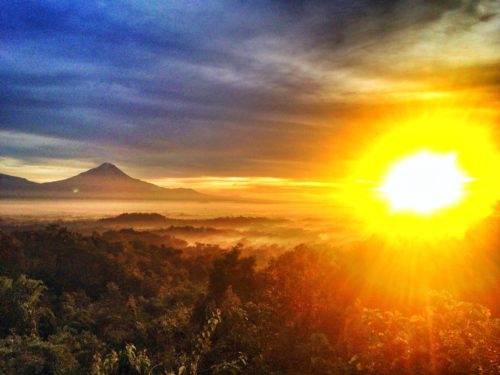
I signed up for a tour through my hostel that would take me to Borobudur and Prambanan in one day. It all started with an early 3:45am pickup in a comfortable air-conditioned bus. We slowly made our way to watch sunrise at Punthuk Setumbu Hill rising up over Borobudur. When we arrived just after 5:15am, the sun was already visible.
Personally, the views at sunrise over Borobudur area was worth the early wake up to me, but it’s worth pointing out… there are two different experiences to choose from.
Two Different “Sunrise” Experiences at Borobudur
This trips up a lot of travelers, so it’s worth spelling out clearly. There are two completely different ways to catch sunrise near Borobudur:
- Punthuk Setumbu Hill (what I did): An external viewpoint about a 10-minute walk from a nearby hilltop, roughly an hour’s drive from Yogyakarta. You watch the sunrise over the valley with Borobudur visible in the distance, mist and all. This is the classic, Instagram-famous shot, arranged through most hotels or tours, and much cheaper than the option below.
- “Sunrise at the Temple” (official ticket): An exclusive ticket that lets you enter Borobudur itself at 4:00am, ahead of regular opening, and watch the sun rise from the monument. This costs around IDR 1,000,000 (~$65) per person. It’s far more than the regular admission and is capped at a hundred visitors a day. It reopened in mid-2025 after a long pandemic-era closure.
Neither is “wrong”. They’re just very different experiences and price points. If you want the classic hillside photo, book the Setumbu Hill option. If you want to be inside Borobudur at dawn, you need the official Sunrise ticket, booked well in advance.
Borobudur Tickets and the Climb
Borobudur Hours: 8:00am – 4:00pm Monday – Sunday
A short walk from the front gate brings you your first views of Borobudur. The temple itself is grand. It’s a large rectangular fortress with tiers of stairs scaling all four sides, bells and Buddhas everywhere. The top level has the best views, but it was also the most crowded part when I was there. Circling the lower levels, you can often find yourself alone for a few minutes and grab quieter photos.
Here’s the current ticket structure for foreign visitors:
- Sunrise ticket (~IDR 1,000,000 / $65): Covers early 4:00am entry as described above. Limited to 100 people.
- Temple Structure / Climb-Up ticket (~IDR 455,000 / $30): Access to the park and grounds surrounding the temple. You can do a guided climb to the upper terraces at a booked time slot. There are 8 time slots per day. It’s best to book in advance.
- Sunset ticket (~IDR 1,000,000 / $65): Covers 4:00pm entry. Limited to 100 people.
Book your tickets in advance. 3 to 7 days ahead is safest in peak season (June–August, December–January), since morning slots sell out fastest. Buying on arrival is possible but risky. You may only get an afternoon slot, or miss the climb entirely if the daily quota is full.
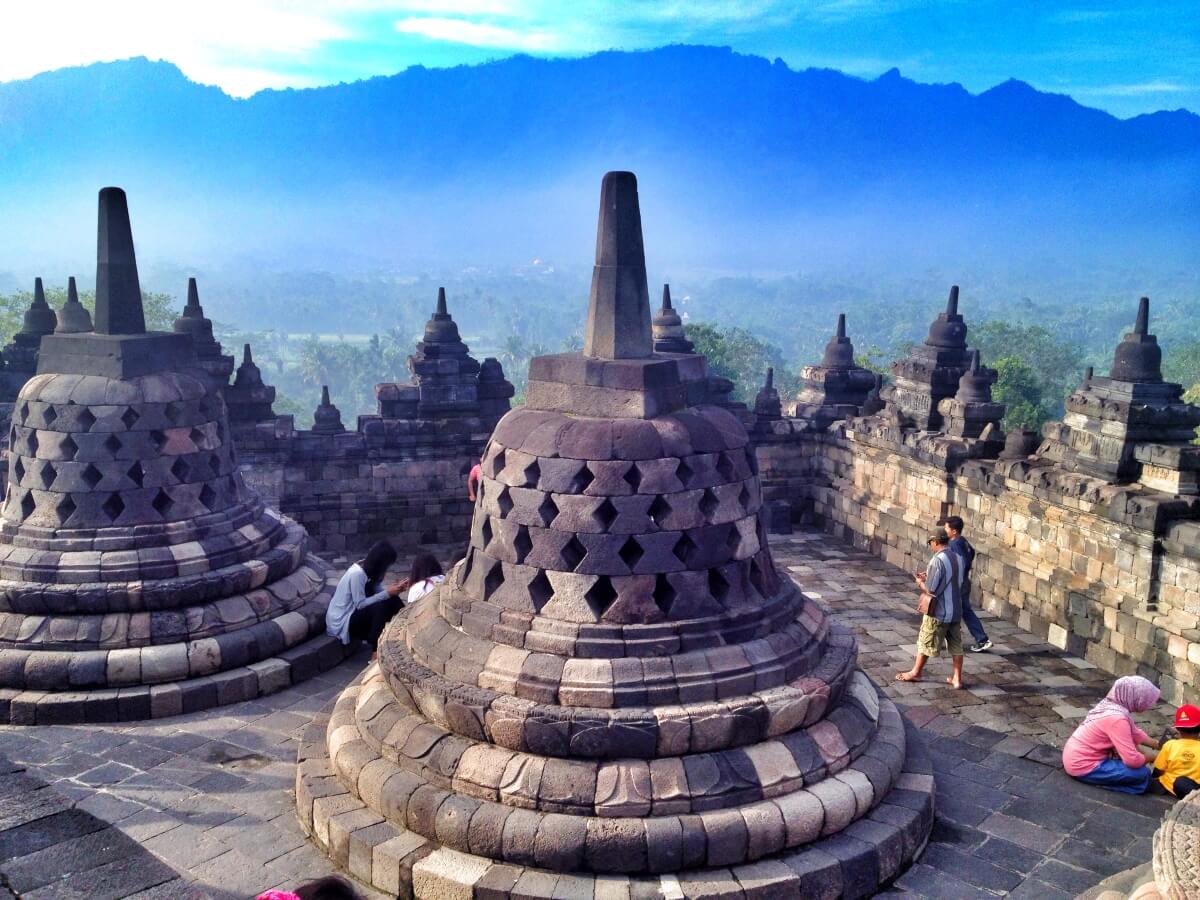
My Experience at Borobudur
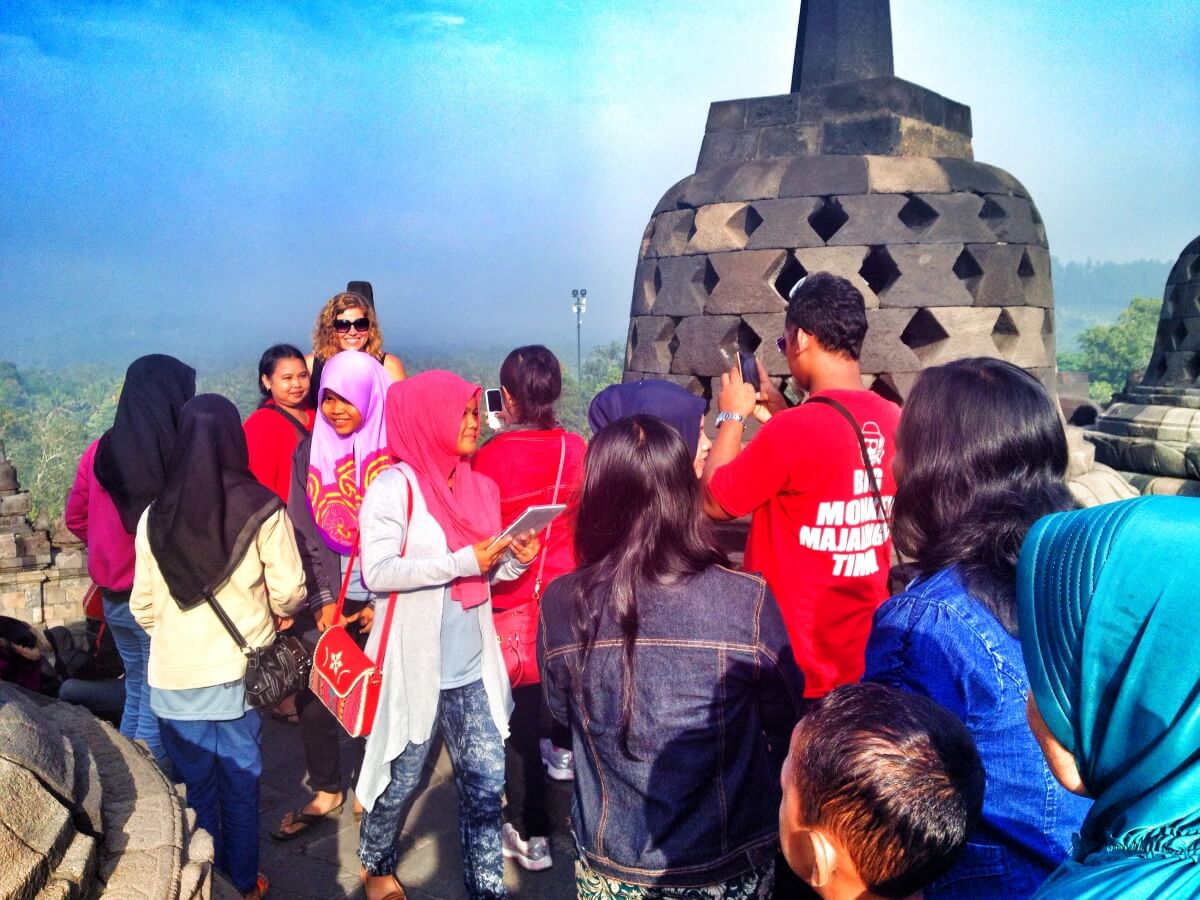
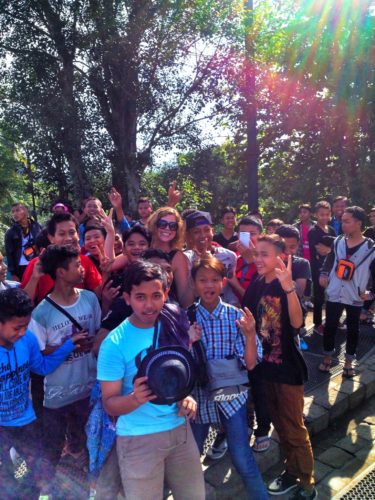
When I was there, it became crowded quickly in the morning, and we (my tall self and my two very tall Australian friends) were often stopped for photos with domestic tourists who were just as excited to meet us and take pictures with us as we were to see the temple.
We were also subjects of a few school assignments asking questions about you to help the students learn English. I think the most adorable part is how flustered the younger kids would get with big smiles, giggles, and jumps for joy after talking to you or taking a photo. It’s like being a celebrity. In fact, I think it was the most overwhelming time it’s ever happened rivaling the Forbidden City in China. I can’t make this stuff up. In case you don’t believe me, we took some photos as well…
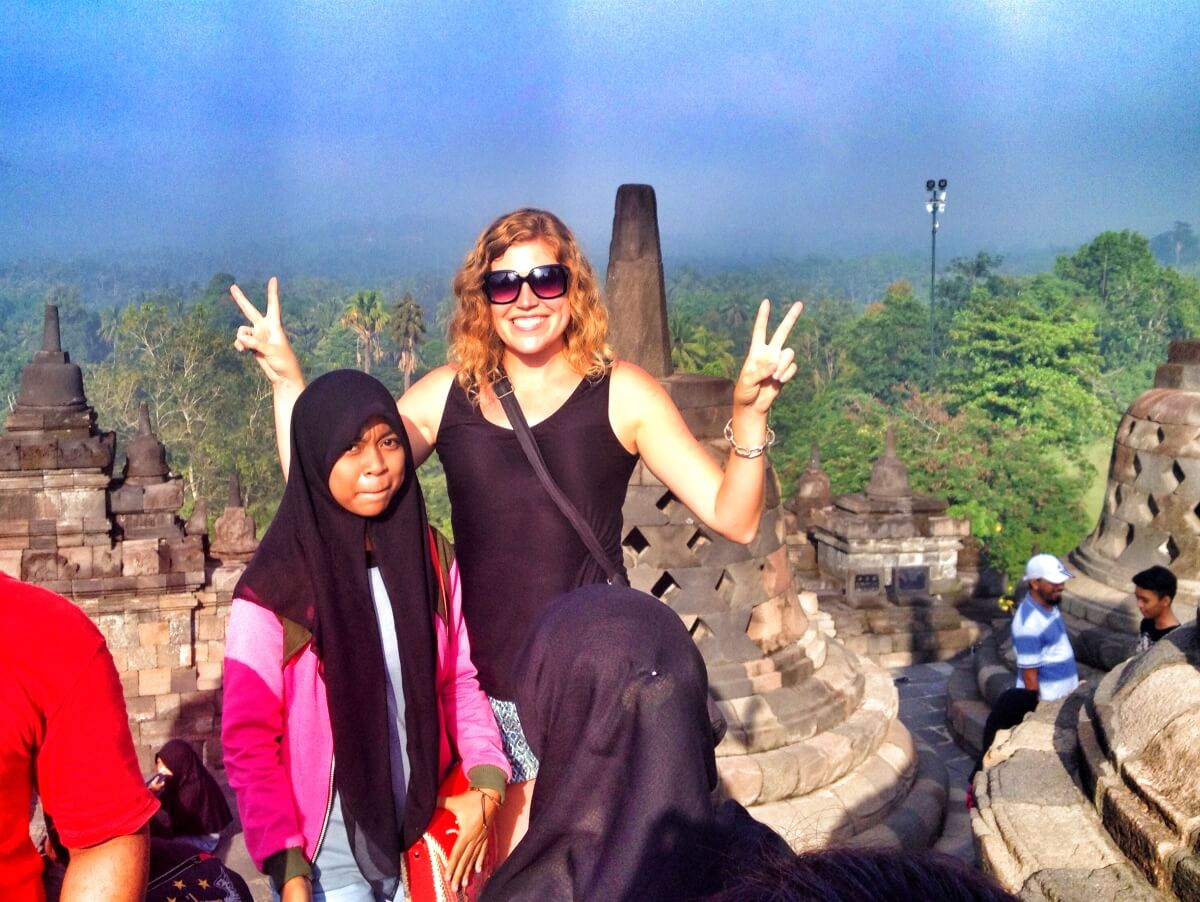


Also on the temple grounds are some elephants, but give yourself time to exit. It’s easily a 20-minute walk through stalls selling everything from clothing to food to souvenirs. Take note of where your van or driver is parked, since the exit area gets busy as the day goes on.
Don’t Miss Candi Pawon and Candi Mendut (Next Door)
If you have extra time, two smaller temples sit within the greater Borobudur complex: Candi Pawon (a flat, easy walk east of the old entrance) and Candi Mendut, a further mile or two (2km) east and still a working Buddhist monastery. A combined ticket for both runs around IDR 20,500 for foreign visitors. It’s a nice, low-key add-on if you’re not rushing to Prambanan.
About Prambanan: Why It’s So Famous
Prambanan is Indonesia’s largest Hindu temple complex, and visually, it couldn’t be more different from Borobudur. Rather than one massive stacked monument, Prambanan is a cluster of tall, slender towers, the tallest reaching about 47 meters, dedicated to the Hindu Trimurti: Shiva as the primary deity, alongside Brahma and Vishnu.
Construction began around 850 CE, likely under the Sanjaya dynasty of the Mataram Kingdom, not long after Borobudur was completed just 25 miles (40 km) away, a reminder of how closely Hindu and Buddhist communities coexisted in ancient Java.
The Shiva Temple at the center is the tallest and most spiritually significant building in the complex, and its courtyard layout reflects a hierarchy typical of Hindu temple architecture, moving from outer, more public space toward an innermost, most sacred zone. Inside, it houses statues of Shiva alongside the Lokapala, the guardian deities of the cardinal directions.
The Brahma Temple contains statues of the brahmins credited with writing the Vedas, while the Vishnu Temple features a statue of the god flanked by two apsaras. Together, the complex is often called Candi Loro Jonggrang (“Slender Maiden”), a name tied to a local legend about a princess and a scorned suitor.
Prambanan’s Three Tiered Courtyards
- Outer Yard (Jaba): The largest zone surrounding the complex, once a transitional space where pilgrims prepared before entering more sacred ground. Few structures remain here, but it gives a sense of Prambanan’s original scale.
- Central Courtyard: Once filled with hundreds of smaller ancillary temples arranged in rows. Most are now in ruins, but what remains still hints at how vast and structured the complex once was.
- Inner Court (Njeron): The most sacred zone, home to the three main temples: Shiva, Brahma, and Vishnu.
Wrapped around the base of the main towers, relief panels carved in stunning detail depict the Ramayana, one of Hinduism’s great epics, illustrating its moral teachings, struggles, and stories, carved in a style distinct enough from Indian originals that art historians consider it an Indonesian interpretation.
Damaged repeatedly by earthquakes and volcanic eruptions over the centuries, Prambanan has been under active restoration since 1918 and remains, alongside Borobudur, one of the two main UNESCO World Heritage Sites in the region.
Prambanan Location
Prambanan is located in a border area between Central Java and the Special Region of Yogyakarta, about 10 miles (17 km) northeast of Yogyakarta city center, roughly a 30 to 45 minute drive. Unlike Borobudur, it sits right along the main road connecting Yogyakarta and Solo, so it’s easy to reach without a long detour.
Yogyakarta is again the natural jumping-off point, for the same reasons as Borobudur. It has the airport, the hotels, and the bulk of tour operators. A couple of alternatives:
- Solo (Surakarta): About 40–50 minutes from the other direction, sometimes used as a base by those approaching from that side rather than from Yogyakarta.
- Klaten: A smaller town closer still (about 15–20 minutes away), occasionally used by those with their own transport, though it has far fewer accommodation options.
Since Prambanan and Borobudur sit in roughly opposite directions from Yogyakarta, most people still stage from there and treat it as two separate legs of a day (or two days), rather than trying to base out of a smaller town near just one temple.
Visiting Candi Prambanan
After a couple of hours exploring Borobudur, most day trips head to Prambanan, roughly 1.5–2 hours away. Prambanan isn’t quite as large as Borobudur, but it’s arguably more visually striking. It features a cluster of tall, narrow towers rather than one massive structure, closer in style to Angkor Wat.
Prambanan Ticket Prices
For foreign adults, you’re looking at approximately IDR 400,000 (~$25). Children pay a reduced rate of IDR 250,000 (~$15). There’s no combo discount with Borobudur anymore (like there was when I visited), so budget for it as a separate, full-price stop.
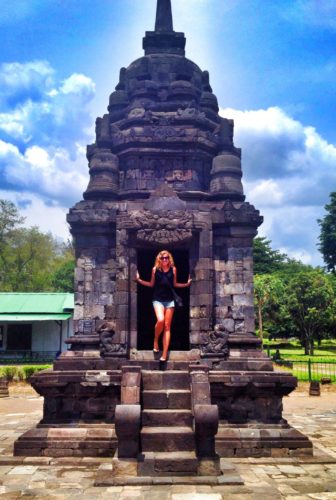
Don’t Visit on a Monday
Prambanan undergoes maintenance every Monday. This means, visitors can only view the three main towers from behind a rope barrier rather than entering the inner courtyard. If your trip lands on a Monday, either shift your Prambanan visit to another day or focus your time on Candi Sewu instead, which stays fully open.
Next to Prambanan are three smaller temple complexes. The first has a few small buildings, the second is mostly ruins, but the third, Candi Sewu, is worth the extra ten-minute walk. It’s Indonesia’s second largest Buddhist temple complex (after Borobodur), and far less crowded than Prambanan’s main towers. I spent nearly as much time there as at Prambanan itself. Best of all? There were only 2 – 3 other people in Candi Sewu, a stark contrast to Prambanan or Borobudur.
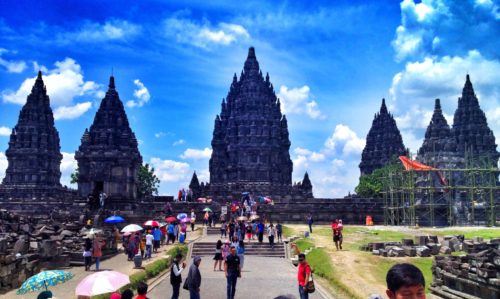
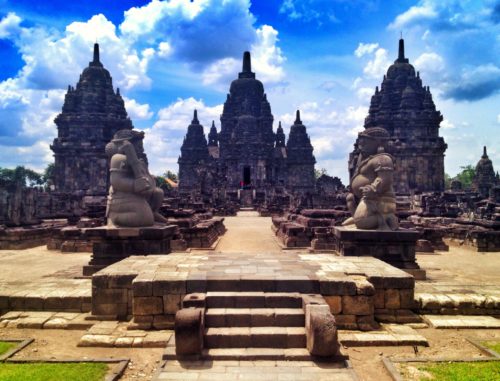
Pro Tip: Pack sunscreen and water. Prambanan’s grounds offer more shade than Borobudur’s exposed platforms, but midday sun is still intense.
Budgeting for the Day
Here’s a realistic per-person cost breakdown for 2026, in USD:
| Item | Cost |
|---|---|
| Borobudur Temple Structure ticket | ~$30 |
| Prambanan entrance ticket | ~$25 |
| Private driver for the day (split among group) | ~$15–65 depending on group size |
| Lunch | ~$5–10 |
| Total (solo traveler, private driver) | ~$75–130 |
| Total (small group, cost split) | ~$60–90 per person |
Organized tour packages that bundle transport, tickets, and a guide run anywhere from about $75 to $325 per person depending on inclusions and group size. The wide range mostly reflects private vs. shared tours and whether the premium Sunrise ticket is included.
Public transportation drops the temple visits themselves to entrance-fee cost only, but realistically limits you to one temple per day given the transit time.
My Recommendation
Honestly, rather than piecemeal the day together. Booking a tour is the easiest (and fairly cost effective) way to go. This is what I opted for and it really did make the day go smoothly and allow me to see everything I wanted to in one day.
If you want to experience sunrise (which is incredible), check out the Borobudur Sunrise from Setumbu Hill, Merapi Volcano, & Prambanan Full Day Tour. If early mornings aren’t your thing, don’t force it. Go for a Borobudur Temple & Prambanan Temple Private Day Tour.
The tours take care of all of the logistics, ticket concerns, language barriers, and transportation to leave you to just enjoy these two amazing temples.
Practical Tips for Borobudur and Prambanan
- Book Borobudur’s ticket online in advance. This is the single most important change from a few years ago. Don’t count on getting a good time slot (or any slot) by just showing up.
- Visit Borobudur first, in the morning, when it’s cooler and before crowds peak. Save Prambanan for the afternoon, when its shadier grounds are more bearable.
- Skip Mondays for Prambanan’s main towers if you can help it.
- Bring cash for the small stuff. Think food stalls, drinks, and the walk out through the souvenir stands at both sites.
- Student discounts technically exist but are inconsistently honored. University ID cards without a clear “Student” designation and expiration date are often rejected at the gate. Don’t count on it as a guaranteed discount.
- Dress modestly for both sites. We’re talking shoulders and knees covered is a safe default, especially since Prambanan is an active religious site. (As you can see from my pictures, this wasn’t a concern when I went… or I was oblivious, which is also possible, but show respect with appropriate dress.)
FAQ about Prambanan and Borobudur
Yes, it’s the most common way to see both, typically with a private driver or organized tour departing Yogyakarta around 7 – 7:30am and returning by 5 – 6pm. It’s a long day, but very doable. If you want to do sunrise, it will be even longer!
Yes, especially if you want to climb to the top. The daily quota is limited, and morning slots can sell out 3 – 7 days ahead during peak season. Once you know when you’re going, secure your ticket or tour!
Yes, but only with a Temple Structure ticket, a mandatory guide, and a booked time slot. Free climbing without a ticket is no longer allowed.
No, unfortunately the combination ticket was discontinued in 2025. Each temple requires a separate, full-price ticket.
Setumbu Hill is an external viewpoint where you watch sunrise over the valley with Borobudur in the distance. It’s both cheaper and more common. The official Sunrise ticket lets you inside the temple itself before regular opening, at a much higher price.
Explore More of Indonesia
After your day trip to Borobudur and Prambanan, you’ll definitely want to explore more of Indonesia to really get to know this beautiful country. Don’t miss the opportunity to explore some of these destinations.
- Day Trip to Borobudur and Prambanan: The Complete Guide
- Visiting Mount Bromo, Indonesia: An Active Volcano
- Gili Trawangan Travel Guide: Which Gili Island is Right for You?
- Where is Bali? Location, Maps, Fast Facts, and More!
- 10 Best Things to Do in Yogyakarta: Culture Capital of Indonesia
- 1 Day in Jakarta: 24 Hour Itinerary in the Capital City
- How to Hike to Ijen Crater and the Blue Flames
- 4 Day Boat Trip to Komodo Island with Komodo Adventure and Beyond
- Renting a Motorbike to Get Off the Beaten Path in Lombok
- Kuta, Bali: Paradise for Australians?
Like this post? Pin it.