Where is Costa Rica? Location, Maps, and Facts
When planning a trip to Costa Rica, one of the first things to nail down is exactly where it is. Understanding Costa Rica’s location on the map will help you decide when to visit, what to pack, and what to expect when you arrive, from the climate and landscapes to border crossings and flight times.
We’ll explore Costa Rica’s geographic location and how it shapes the country’s weather, biodiversity, and culture. Plus, we’ll answer some of the most common questions travelers have about where Costa Rica sits in Central America and what continent it’s actually on.
Disclosure: Some of the links below may be affiliate links. At no additional cost to you, I may earn a small commission if you make a purchase.
Costa Rica’s Location
Costa Rica is located in Central America, bordered by Nicaragua to the north and Panama to the south. It sits between the Pacific Ocean to the west and the Caribbean Sea to the east, a geographic position that gives it two completely different coastlines, each with its own distinct character.
This dual-coast location, combined with its mountainous interior and proximity to the equator, is a big reason why Costa Rica is home to an extraordinary range of ecosystems. In a country roughly the size of West Virginia, you’ll find cloud forests, active volcanoes, dry tropical forests, and coral reefs, often just a few hours’ drive apart.
Where is Costa Rica on the map?

Costa Rica is situated in the southern part of Central America, between approximately 8° N and 11° N latitude and 82° W and 86° W longitude. It’s northeast of South America, southeast of Mexico, and directly south of Nicaragua.
From a U.S. perspective, Costa Rica is about 2,000 miles (3,200 kilometers) south of Miami, roughly a three-hour flight. It’s often thought of as part of the Caribbean, but Costa Rica is firmly in Central America, not the Caribbean islands.
What countries border Costa Rica?
Costa Rica shares a land border with two countries:
- Nicaragua to the north (approximately 185 miles / 309 kilometers of shared border)
- Panama to the south (approximately 205 miles / 330 kilometers of shared border)
Both borders are accessible overland and are common crossing points for travelers doing longer trips through Central America. Costa Rica also has maritime borders in both the Pacific and the Caribbean.
Planning Tip: If you’re planning to travel overland into Costa Rica from Nicaragua or Panama, make sure to check current border crossing hours and any entry requirements, as these can vary. Most visitors to Costa Ric fly into San José (Juan Santamaría International Airport) or Liberia (Daniel Oduber Quirós International Airport).
Interactive Map of Costa Rica
Take a look at where things are in Costa Rica and how it relates to its neighboring countries in the map below.
How big is Costa Rica?
Costa Rica covers approximately 19,730 square miles (51,100 square kilometers), making it roughly the same size as the state of West Virginia or the country of Slovakia. It’s about 300 miles (480 kilometers) long and between 75 and 175 miles (120 to 280 kilometers) wide.
Despite its compact size, Costa Rica offers amazing biodiversity. The country contains an estimated 5% of the world’s species, despite covering just 0.03% of Earth’s surface. That density of wildlife and landscape variety is a major reason why it’s one of the most visited countries in the Americas.
How Costa Rica’s Location Affects Its Climate
Costa Rica’s position near the equator means it’s warm year-round. There’s no winter in the traditional sense. However, the country does have two distinct seasons: the dry season (roughly December to April) and the rainy season (roughly May to November). These are also referred to locally as summer and winter, which can confuse visitors from the Northern Hemisphere.
One important nuance is the climate varies significantly depending on which side of the country you’re on. The Pacific coast has the most pronounced dry season, making it the most popular time for beach vacations. The Caribbean side, by contrast, receives rain throughout much of the year, with its driest months typically falling in September and October, the opposite of the Pacific.
The mountainous interior (including the Central Valley, where the capital San José is located) stays cooler year-round, often in the 60s–70s°F (15–24°C), even while the coasts are hot and humid.
Does Costa Rica have seasons?
Yes, but not like you might expect. Costa Rica doesn’t have four seasons. Instead, it has a dry season and a rainy (or “green”) season. Here’s how they break down:
- Dry Season (December – April): This is considered peak travel season, especially January through March. Expect sunny days, lower humidity, and higher prices at popular destinations.
- Rainy Season (May – November): The country gets lush and green during this time. Rain typically falls in the afternoons, leaving mornings clear. This is also the shoulder/off-peak season, with lower prices and fewer crowds.
Pro Tip: Don’t write off the rainy season. Costa Rica in the green season can be absolutely stunning. Waterfalls are at their peak, wildlife is active, and you’ll share popular spots with far fewer tourists. I’ve gone twice in November and it’s been magical!
Costa Rica’s Geographic Highlights
Costa Rica’s location at the intersection of two tectonic plates and two oceans has created an incredibly varied landscape. Here’s a taste of what to expect:
- Volcanoes: Costa Rica has over 200 volcanic formations, with several active ones you can visit. Arenal Volcano is the most iconic. It looms over a lake and the popular La Fortuna area. Poás and Irazú are also accessible day trips from San José.
- Cloud Forests: The Monteverde Cloud Forest Reserve is one of the most famous in the world, sitting at roughly 4,600 feet (1,400 meters) elevation. Walking through the misty canopy here is an unforgettable experience.
- Two Coastlines: The Pacific coast is known for big surf, dry tropical forests, and world-class sportfishing. The Caribbean coast has a distinctly different vibe, calmer waters, lush rainforest, Afro-Caribbean culture, and some of the best snorkeling in the country.
- National Parks: About 25% of Costa Rica’s land is protected. Corcovado National Park on the Osa Peninsula is often called one of the most biologically intense places on Earth by National Geographic. Manuel Antonio, Tortuguero, and Cahuita are other standouts.
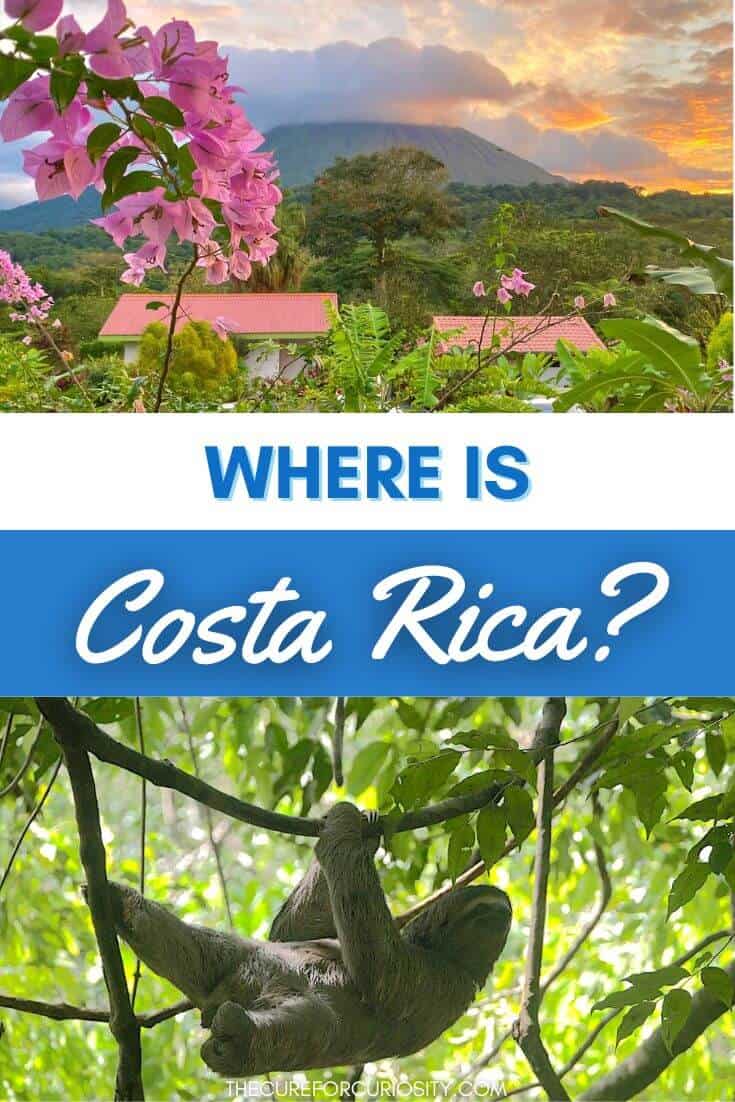
- Wildlife: Costa Rica is home to sloths, toucans, resplendent quetzals, sea turtles, scarlet macaws, monkeys, jaguars, and hundreds of frog and butterfly species. You don’t have to go deep into the jungle to see it. Wildlife is visible even in many beach towns and lodges.


What Continent is Costa Rica On?
This is a question that trips up more people than you’d expect. Costa Rica is in Central America, which is geographically part of the North American continent. It sits on the same landmass as Mexico, Guatemala, Honduras, and the other countries of Central America, all of which are technically North American by geographic classification.
However, in cultural and travel terms, Costa Rica is often grouped with Latin America or Central America as distinct regions. So when people ask “is Costa Rica in South America?”, the answer is no. It’s in Central America, which is part of North America geographically.
That said, Costa Rica’s culture, Spanish language, and Afro-Caribbean influences along the coast make it feel uniquely its own. It doesn’t feel like “North America” in the way that the United States or Canada do. It’s very much a Central American nation with its own identity, shaped by Indigenous roots, Spanish colonialism, and a strong conservation culture.
Is Costa Rica Its Own Country?
Yes. Costa Rica is a fully independent, sovereign nation. It has its own government, elected president, constitution, and foreign policy. It’s been an independent country since 1821, when it (along with the rest of Central America) declared independence from Spain.
One of the most notable things about Costa Rica is that it abolished its military in 1948. It’s one of only a handful of countries in the world with no standing army, a fact Costa Ricans are proud of. The money that would have gone to the military has been redirected toward education and healthcare. Costa Rica consistently ranks highly in Latin America for both.
Is Costa Rica part of the United States?
No, Costa Rica is not part of the United States. It is a fully independent country with its own government. U.S. citizens need a valid passport to visit and can stay for up to 90 days without a visa.
Costa Rica does have strong economic and cultural ties to the United States. Many Americans visit each year and there is a significant expat community. But it is an entirely separate, sovereign nation.
What currency does Costa Rica use?
Costa Rica’s official currency is the Costa Rican colón (CRC), named after Christopher Columbus (Cristóbal Colón in Spanish). Exchange rates fluctuate, but you’ll typically get between 500–550 colones per US dollar.
That said, U.S. dollars are widely accepted throughout Costa Rica, especially in tourist areas, hotels, and restaurants. Many places list prices in both currencies. Smaller local sodas (traditional Costa Rican restaurants) and markets are more likely to prefer colones.
Pro Tip: ATMs are widely available in cities and tourist towns and are often the easiest way to get local currency. Just be aware that some ATMs charge foreign transaction fees, so it’s worth checking with your bank before you go.
Do I need a passport to visit Costa Rica?
Yes, U.S. citizens need a valid passport to enter Costa Rica. You do not need a tourist visa for stays up to 90 days. However, you are required to have proof of onward travel (a return or exit ticket) and sufficient funds for your stay.
Your passport must be valid for the duration of your stay, but some airlines and border agents prefer it to have at least six months of validity remaining, so check before you travel.
Explore More of Costa Rica
So, can you now answer where is Costa Rica? It’s a small but remarkable country in Central America, bookended by two coastlines and packed with more biodiversity, adventure, and warmth than most places ten times its size.
Go to soak in hot springs near Arenal, zip-line over the Monteverde canopy, and spot sloths from the deck of a jungle lodge. It’s worth it.
Here are some additional articles to help you plan your trip to Costa Rica:
- Where is Costa Rica? Location, Maps, and Facts
- Inside Look at Dreams Las Mareas in Costa Rica: An All-Inclusive Resort
Like this post? Pin it for later.