

Epic 2 Week Patagonia Itinerary: Travel Guide to an Outdoor Paradise
Planning your Patagonia itinerary can be challenging. With endless glaciers, mountains, turquoise lakes, hiking, camping, and more, how do you choose what to include? This outdoor paradise will wow you and keep you coming back for more, but your first trip should be awe-inspiring.
Make the most of your 2 weeks in Patagonia with this fun-filled 14 day Patagonia itinerary. It takes you through some of the best parts of Argentina and Chile in this stunning region.
Disclosure: Some of the links below may be affiliate links. At no additional cost to you, I may earn a small commission if you make a purchase.
2 Week Patagonia Itinerary
One of the key ways to make the most of two weeks in Patagonia, is to plan a one-way itinerary. By flying in and out of different locations, you avoid backtracking and maximize your time and money on experiencing the region.
A one-way Patagonia itinerary also allows you to add a few days on at the beginning or end of your trip to take full advantage of two of the best cities in South America: Buenos Aires, Argentina and Santiago, Chile.

Day 1: Buenos Aires, Argentina
This 14 day Patagonia itinerary starts in Buenos Aires, the largest city and capital of Argentina. Known as the “Paris of the South”, you’ll find a combination of rich architectural and cultural heritage making it one of the world’s best capitals.
Fly into in Buenos Aires
Fly into Buenos Aires, Argentina to kickoff your trip to Patagonia. Here you can plan to spend as many days as you want to explore all the splendor of this gorgeous city before proceeding south into the Patagonian region of Argentina.
How to Spend Your Time in Buenos Aires
To get to really know Buenos Aires, I’d recommend spending about 3 days in the city, if you can spare it. This will give you time to check out the highlights of Buenos Aires and the option to take a day trip to one of the amazing surrounding areas. Top day trips from Buenos Aires include Colonia del Sacramento in Uruguay or the Tigre Delta and San Isidro.
One of my favorite ways to get an overview of a new city is to kick off the trip with a free walking tour. And Buenos Aires is no exception! These tours are free to attend. You simply tip the guide at the end based on what you feel the tour is worth. Or, if you prefer, you can take a private guided walking tour to tailor it to your interests.
From there, set out into the city to check out all Buenos Aires has to offer – which is plenty!
Where to Stay in Buenos Aires
Buenos Aires offers many beautiful neighborhoods, which can make it difficult to choose where to stay. If it’s your first time visiting the city, stay in Palermo. It is in the heart of the city and offers lively bars, restaurants, and cafes!
Check out Apart Hotel Shoshana for a budget friendly room or Mine Hotel for a bit more luxurious of stay. Both put you within walking distance of this lively neighborhood!

Day 2 – 3: El Chalten, Argentina
It’s time to head south to Argentinian Patagonia! Your first stop in Patagonia will be El Chalten, a small village of about 1,500 people located within Los Glaciares National Park. It is known worldwide as the “National Capital of Trekking in Argentina” and a must visit on your Patagonia itinerary!
Gateway to many famous trails, including the peaks of Cerro Torre and Mount Fitz Roy, El Chalten is an unforgettable place to visit. In fact, it took second place in the Lonely Planet travel guide for “Best Cities in the World to Know” in 2015 – the first city in Argentina to make the list!
Fly from Buenos Aires to El Calafate
To get to El Chalten from Buenos Aires, you’ll first need to take an early morning flight from Buenos Aires to El Calafate. This 3 hour flight will take you south into the Argentinian Patagonia region and the ultimate launching point for your Patagonia itinerary.
Bus El Calafate to El Chalten
Once you land in El Calafate, catch a bus directly to El Chalten. There are frequent buses running this route. They typically starting in El Calafate town, then stop at the El Calafate airport, and then they continue on to El Chalten. The ride will take between 2-3 hours and will put you into El Chalten by mid-afternoon. Keep your eyes open as the scenery is a great introduction to the beauty of the region!
Note that you can book your buses ahead of time, or you can try your hand at finding a bus when you land. If you’re on a tight timeline with just two weeks in Patagonia, I recommend booking ahead!
How to Spend Your Time in El Chalten
Upon arrival in El Chalten, you’ll want to take advantage of the remaining daylight. The ultimate way to do this is to take a “short” hike up to the Mirador Condores (Condor Lookout) and Mirador Las Aguilas (Eagles Lookout).
The trailhead for this hike sits near the entrance to town and the route will take you about 3.3 miles with just under 700 ft elevation gain in 2 hours. It’s a perfect warm up for those hiking muscles!
The next morning, strap on your boots bright and early to make your way up to Laguna de los Tres at the base of Mount Fitz Roy and Cerro Torre. This hike and the views it provides are the primary reasons for coming to El Chalten.
Fun Fact: Mount Fitz Roy is the mountain used as the basis of the Patagonia brand logo.
To reach this epic sight, there are many trail options. There are also many treks that will take you further into the Southern Patagonian Ice Field. All of the options offer great rewards at varying difficulty and distances. For example, one of my favorite add-ons to Laguna de los Tres is to head over to Mirador Piedras Blancas to check out this impressive glacier.
Know what to pack for a day hike with the Essential Hiking Packing List
If you don’t feel confident hitting the trails in El Chalten alone, consider taking a hiking tour. You can select from options like this hiking day trip to base camp of Mount Fitz Roy or go further with a 2 day hiking tour of Fitz Roy and Cerro Torre.
Alternatively, if you are not a seasoned hiker, you can opt to base yourself in El Calafate for days 2-3 of your Patagonia itinerary and just take a day trip to El Chalten from El Calafate.
Want to know more? Check out 9 Best Things to Do in El Chalten, Argentina: A Hiker’s Paradise
Where to Stay in El Chalten
El Chalten is a small town catering mostly to backpackers and hikers. As such, you can stay anywhere in town and still be able to walk to the main trails and restaurants. Check out Rancho Grande for basic, inexpensive accommodations or the Chalten Suites Hotel for a classier hotel feel.
For more adventurous accommodations, check out the Patagonia Eco Domes. They are located 6 miles out of town with views over Fitz Roy hill and offer a bit of luxury off the beaten path.
Learn more in the Complete Guide to El Chalten.

Day 4 – 5: El Calafate, Argentina
Continue your journey into Patagonia with El Calafate. El Calafate is a premier tourist destination in Patagonia offering one of the best airports in the Argentinian Patagonia region. It’s also the hub for visiting Los Glaciares National Park and Perito Moreno Glacier.
Bus from El Chalten to El Calafate
Return to El Calafate from El Chalten in the morning by bus. It will take about 3 hours to get into town.
How to Spend Your Time in El Calafate
Upon arrival in El Calafate, head out to Perito Moreno Glacier – the most famous sight in the El Calafate region.
Buses to Perito Moreno leave from El Calafate at 8am and 1pm. By arriving to El Calafate in the morning, you can catch the 1pm bus for a self-guided tour of this spectacular glacier. The bus takes around 2 hours to reach Perito Moreno and return buses run at 4pm and 7pm. This gives you plenty of time to witness the stunning glacier. Alternatively, you can take a tour from El Calafate to Perito Moreno to minimize logistic, and it includes a boat tour.
This two week Patagonia itinerary provides another day in El Calafate to enable you to continue your exploration of the area and its amazing experiences. The options are endless, but here are some recommended activities in the area for your “free day”:
Alternatively, if you are not interested in the above activities, you can re-allot this day elsewhere to spend more time hiking in the mountains.
Learn all about the 18 Best Things to Do in El Calafate!
Where to Stay in El Calafate
Calafate has a central tourist strip, as well as some more residential areas. To make the most of your time in Calafate, stay centrally. This enables you to walk to all of the restaurants, shops, and tour agencies.
Fortunately, in being a big tourist hub, there are quite a few amazing and inexpensive hostels in El Calafate. Try Folk Hostel, America del Sur Calafate Hostel, or Calafate Hostel for budget friendly stays. Alternatively, you can try someplace a little nicer like Linda Vista Apart Hotel or Hotel Posada Los Alamos.
Determine Where to Stay in El Calafate: Hotels for All Budgets

Day 6: Puerto Natales, Chile
Continue on your Patagonia journey by crossing from Argentina into Chile on your way from El Calafate to Puerto Natales. Puerto Natales is the jumping off point for the famous Torres del Paine National Park and therefore sees quite a few visitors.
You won’t however need much time in town – just enough to prep for hiking in Torres del Paine National Park.
Bus from El Calafate, Argentina to Puerto Natales, Chile
Today is mostly a travel and prep day. Take an early bus from El Calafate across the Argentina/Chile border to Puerto Natales.
How to Spend Your Time in Puerto Natales
By taking an early bus, you will get to Puerto Natales in time for the 3pm Erratic Rock W Trek prep talk. This informative session will give you insight into what to expect along the trek and what you should pack.
Afterwards, you’ll have time to do last minute shopping and prep before setting off on the 5 day W trek tomorrow in Torres del Paine National Park.
Where to Stay in Puerto Natales
This tourist town features a ton of accommodations for those looking to head to Torres del Paine National Park. One of the most important things to consider when selecting a hotel in Puerto Natales is to pick one where you can safely store your belongings that aren’t going hiking with you. After all, you will be leaving them behind for 5 days!
Consider Hotel Vendaval, which offers a terrace with a view, or stay directly on the water at Kau Lodge or Hotel Costaustralis.

Day 7 – 11: W Trek in Torres del Paine National Park, Chile
Torres del Paine National Park is one of the biggest draws of Patagonia. It’s best known for its soaring jagged mountain peaks, bright blue glacial fed lakes, and a quantity of glaciers and icebergs. In fact, it was rated as the fifth most beautiful place in the world by National Geographic in 2013 and the 8th Wonder of the World by TripAdvisor in 2017.
Bus from Puerto Natales to W Trek in Torres del Paine National Park
Start your day bright and early to catch a bus first thing in the morning to Torres del Paine National Park. This 2 hour bus ride will offer some amazing mountain views and deposit you at the Laguna Amarga Entrance of the National Park. This is where you’ll pay the Torres del Paine National Park entrance fee and start your W trek adventure!
How to Spend Your Time in Torres del Paine National Park
The W Trek is a famous five day trek through Torres del Paine National Park. Find everything you need to know for hiking the W Trek in this extensive post. You’ll find everything from which direction to hike to where to stay along the way, what to pack, and more!
Read More: Hiking the W Trek East to West in Torres del Paine National Park
Day 12 – 13: Punta Arenas, Chile
After you’ve completed your 5 day hike in Torres del Paine National Park, you’re going to start winding down your Patagonia itinerary. To kick this off, you’ll be heading even further south to Punta Arenas, home of another popular Patagonian airport.
Bus from Puerto Natales to Punta Arenas
Traveling the 155 miles between Punta Arenas and Puerto Natales will take about 3 hours. Fortunately, buses run regularly with over 40 options per week.
You can book your bus from Puerto Natales to Punta Arenas ahead of time or purchase a ticket directly from the main bus terminal in Puerto Natales.
How to Spend Your Time in Punta Arenas
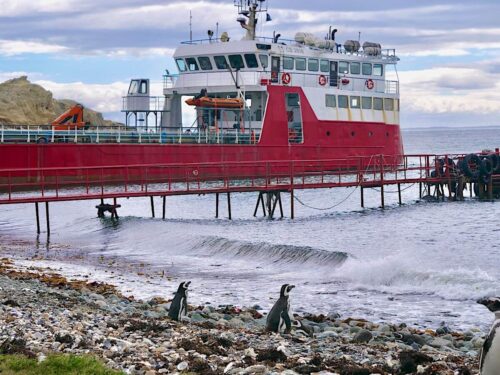
Punta Arenas is one of the southernmost locations in South America. As such, you’ll find some unique activities available in this area, like visiting penguins and Tierra del Fuego by ferry.
To make the most of your time in Punta Arenas, you’ll want to take the morning ferry over to Magdalena Island to admire the huge Magellan penguin colony that lives on the island. You can also do this as a tour if you’d prefer to have the logistics figured out for you. It’s by far one of the best experiences in Punta Arenas!
You’ll also want to explore the city of Punta Arenas, including stopping by the Municipal Cemetery and Fort Bulnes. For the remainder of your time in the area, consider taking in one of the best things to do in Punta Arenas, like going whale and glacier watching or heading to Parque Pinguino Rey to see the King Penguins. If you’re more of an active traveler, you can also go hiking in the Patagonian Andes.
Check out the Ultimate Guide to Visiting the Penguins of Isla Magdalena from Punta Arenas
Where to Stay in Punta Arenas
Selecting a hotel in Punta Arenas is pretty simple. Plan to stay near the Plaza de Armas Munoz Gamero to be able to walk everywhere you need to go.
Innata Casa Hostal and Apart Hotel Endurance are two excellent choices for travelers of all kinds.

Day 14: Santiago, Chile
Wrap up your two weeks in Argentina and Chile with a stop in Santiago, the capital of Chile. This thriving city offers something for everyone. In fact, it is the only city in the world that offers the options of skiing up in the majestic Andes, followed less than an hour later with surfing in the Pacific Ocean. As such, it is an easy place to add on a few extra days, if you have the time.
Fly Punta Arenas to Santiago
To get from Punta Arenas to Santiago, you’ll want to take a 3.5 hour non-stop flight. It’s by far the quickest and easiest ways to cross the 1,900 miles from Chilean Patagonia up to central Chile. Multiple airlines run this route and it tends to be a pretty inexpensive.
How to Spend Your Time in Santiago
Santiago is a big city and offers a lot of awesome things to do. When you first arrive, I recommend taking a free walking tour to get an overview of this sprawling city. English tours run everyday at 10 am and 3pm. It meets in the Plaza de Armas outside of the Cathedral – no reservation needed! Just look for the guide dressed in the red “Free Tour” t-shirt.
This walking tour will take you by many of the key sights of Santiago, including the Plaza de Armas (the main square),the Cathedral, City Hall, Post Office, Pre-Columbian Art Museum, Old Congress Building, Supreme Court, Government House, Santiago Stock Exchange, the Opera House, Santa Lucía Hill, Lastarria Neighborhood, Museum of Fine Arts, Forestal Park, Italy Square, Bellavista Neighborhood, Neruda Museum, and San Cristóbal Hill.
Plan to spend about 4 hours walking around the city with this guided tour and just tip the guide at the end. From the tour, you’ll also get a good sense of where else you want to spend the remainder of your time in Santiago, whether it is in museums or a specific neighborhood. Alternatively, you can take a city tour with less walking, if you’re so inclined.
Additionally, you may want to spend more time in and around Santiago to check out the amazing nearby cities and regions. This could be the coast and beaches of Chile or the mountains or wine regions.
Take a day trip to the colorful coastal cities of Valparaiso and Viña del Mar or to Cajon Del Maipo for scenic waterfalls, glaciers, and cliffs. Alternatively, if you’re looking to just relax, you can go wine tasting in the Casablanca Valley.
Where to Stay in Santiago
Santiago is a large metropolitan city featuring a wide variety of neighborhoods to choose from. To make the most of your time there, stay in Centro to be close to most of the tourist sights, including Plaza de Armas, or select Bellavista to be in the center of the nightlife of the city.
If you want to stay in the center of it all with a bit of comfort and style, try Hotel Magnolia or the Singular Santiago Hotel. For more affordable Centro accommodations try Hostel Boutique Merced 88 or Plaza de Armas Hostel.
If nightlife is more your speed, check out Bellavista with a stay at Hotel Loreto or Bella 269!
Learn More about Visiting Patagonia
Traveling around Patagonia is an adventure that many outdoor enthusiasts are in search of. However, it’s also a bit untouched and off the beaten path, raising many questions along the way.
Here are some of the top things to know as you prepare your Patagonia itinerary!
What country is Patagonia part of?
Patagonia is a geographical region located on the southern end of South America. It is shared by both Argentina and Chile, with the Andes Mountains diving the two countries.
Which is better: Patagonia in Chile or Argentina?
In an ideal world, spending two weeks in Patagonia will take you to both Chilean Patagonia and Argentinian Patagonia. They both feature amazing places that are unique to their country. However, if you have to select one, pick them based on your interests.
Chilean Patagonia is home to Torres del Paine National Park, an outdoor wonderland, filled with days of hiking. Meanwhile, Argentina offers more luxurious day trips to glaciers and easy guided tours. However, you can easily find day trips in Chile and strenuous hiking in Argentina, which is why you should ultimately try to visit both in one trip.
How many days do you need in Patagonia?
Patagonia is a very large region in Chile and Argentina. As such, you’ll need at minimum one week in Patagonia. To truly enjoy it and see the highlights and most beautiful areas, consider a two week itinerary in Patagonia.
If you have all the time in the world, you can easily spend one month or more exploring this beautiful part of the earth.
Can you visit Patagonia on your own?
Yes, you do not need to take a guided tour to Patagonia, you can visit it alone. In fact, it’s pretty simple to navigate on your own, including hiking Patagonia alone. For one, it’s a popular destination and most hiking trails will have other travelers exploring them. For another, it’s one of the safest destinations in South America!
When’s the best time to go to Patagonia?
The best time to visit Patagonia is during the southern hemisphere’s spring and summer, between October and February.
During these months, the weather is more mild, the snow starts to melt, and the tourist industry starts to boom. This means restaurants and hotels tend to all be open and transportation runs more regularly – perfect for planning your trip to Patagonia!
Learn more about the Best Time of Year to Visit Patagonia: Season by Season Breakdown
Find More Patagonia Tips
Traveling in Patagonia for 2 weeks is an incredible adventure, particularly for the outdoor enthusiasts out there. You’ll find the scenery to be some of the most beautiful in the world.
Find more need to know facts about visiting Patagonia in these other posts:
- The Complete Guide to El Chalten, Argentina
- 9 Best Things to Do in El Chalten, Argentina: A Hiker’s Paradise
- 18 Best Things to Do in El Calafate, Argentina
- Where to Stay in El Calafate: Hotels for All Budgets
- Hiking the W Trek East to West in Torres del Paine National Park
- How to Book Campsites in Torres del Paine National Park
- Best Time of Year to Visit Patagonia: Season by Season Breakdown
- Ultimate Guide to Visiting the Penguins of Isla Magdalena from Punta Arenas
Like this post? Pin it for later.




Great article! I’m gonna do this one day!
Thanks Corey! Patagonia is one of my favorite places to date – so beautiful with so many “off the grid” activities!
Thanks Julia, thoroughly enjoyed reading that. Is it feasible to hire a car/jeep for exploring, as I am planning a suprise trip for our 50th anniversary, and we are a bit past the ‘hiking stage !
Thanks again, Tony
Hi Tony! You can definitely get around and explore by car/jeep. The scenery of the area is beautiful and while there are some places/viewpoints you can’t get to without hiking (The Towers in Torres del Paine National Park) there are many places that are accessible without a lot of hiking or walking, like Perito Moreno, Isla Magdalena with the penguins, parts of Torres del Paine, etc. It will still make a memorable trip and a great way to celebrate!