How to Visit Dachau Concentration Camp Memorial from Munich
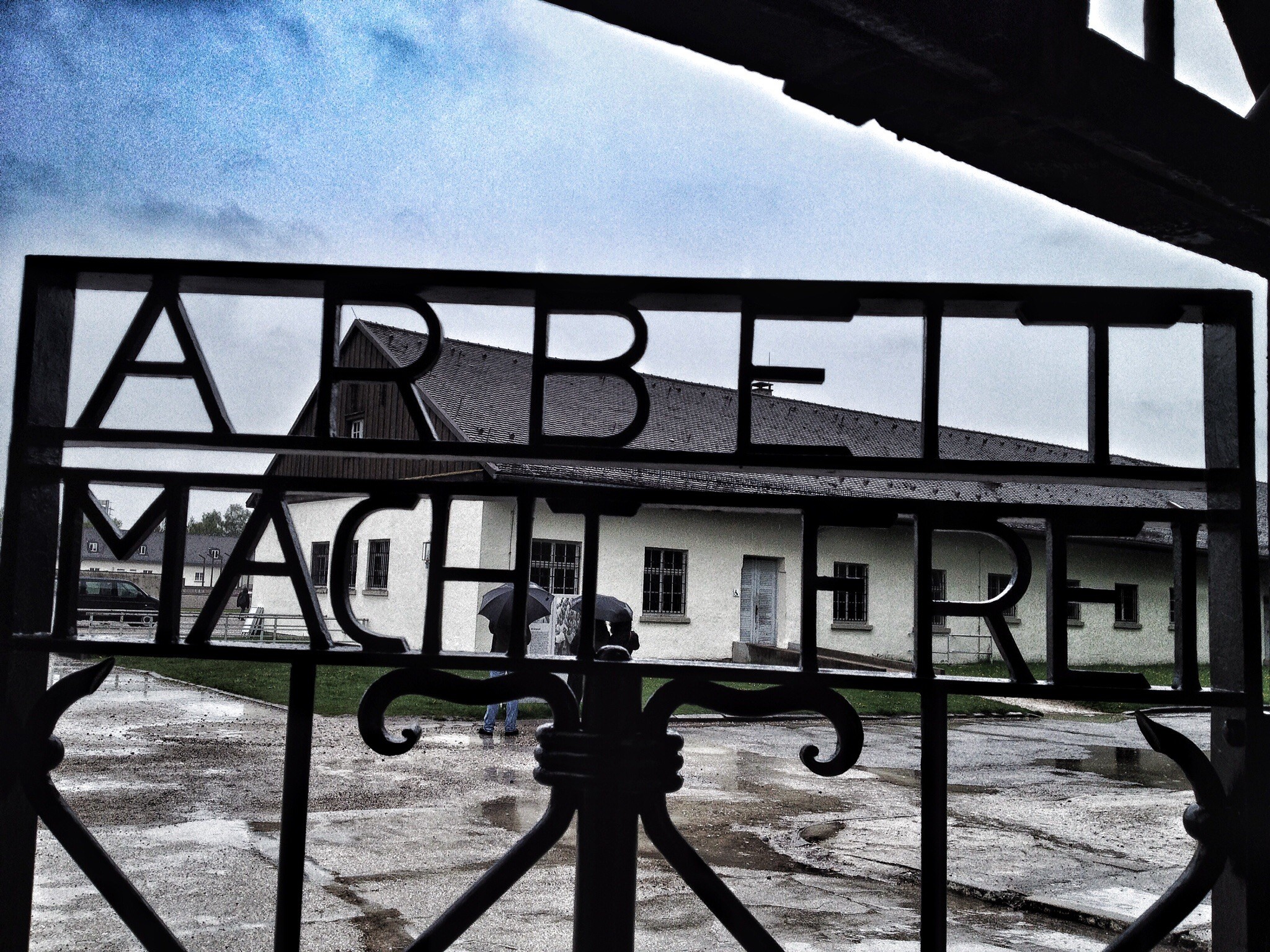
“Arbeit macht frei” or “Work makes (you) free.” That’s what the gates of Dachau say. But for those of you familiar with Dachau, you know that’s a lie.
Visiting Dachau Concentration Camp Memorial is one of the most sobering and important experiences you can have near Munich. While it’s not an easy visit, it’s an important one, a chance to experience history, honor the victims, and ensure these atrocities are never forgotten.
For me, visiting Dachau on the 70th anniversary of liberation was deeply personal. My grandfather was there in April 1945 as part of the US forces that liberated the camp, freeing 32,000 prisoners. Standing where he stood 70 years earlier, I finally understood why he struggled to speak about what he witnessed.
This guide will help you plan your visit to Dachau from Munich, understand what to expect, and prepare yourself for this powerful historical site.
Disclosure: Some of the links below may be affiliate links. At no additional cost to you, I may earn a small commission if you make a purchase.
About Dachau Concentration Camp
Dachau was the first concentration camp built in Germany, opening in March 1933, just weeks after Hitler came to power. Initially used to imprison political opponents, it became the model for the entire concentration camp system.
Unlike extermination camps such as Auschwitz-Birkenau, Dachau was primarily a labor camp. But make no mistake, it was still a death sentence for many. Prisoners endured 12-hour work days, starvation rations, inadequate clothing in freezing temperatures, medical experiments, and systematic brutality.
Key Facts:
- Over 206,000 prisoners passed through Dachau between 1933 and 1945
- At least 41,500 people were murdered here
- Only 32,000 prisoners survived to liberation on April 29, 1945
- Prisoners came from more than 30 countries
- The camp housed political prisoners, Jews, Roma, Jehovah’s Witnesses, homosexuals, and others deemed “undesirable”
Today, the Dachau Concentration Camp Memorial Site serves as a place of remembrance, education, and warning. It’s one of the most important Holocaust memorial sites in Europe.
Learn more about the memorial and its programs on the official Dachud Memorial Site website.
Why Visit Dachau?
It’s an uncomfortable question: Why would anyone want to visit a place of such horror?
For me, it’s simple: we have a responsibility to remember.
Visiting Dachau isn’t about morbid curiosity. It’s about:
- Honoring the victims: The tens of thousands who suffered and died here deserve to be remembered, not forgotten.
- Understanding history: Seeing the camp in person makes the Holocaust tangible in a way that no textbook can.
- Preventing the future: As Holocaust survivors say, “Never forget” means ensuring this never happens again.
- Keeping the memory alive: As the generation of survivors and liberators passes away, we become the generation to remember.
For me personally, visiting Dachau connected me to my grandfather’s experience as one of the liberators on Dachau back in 1945. More on that later…
How to Get to Dachau from Munich
Dachau is located about 10 miles (16 kilometers) northwest of Munich and is easily accessible by public transportation. Most visitors make it a half-day or full-day trip from Munich.
By Public Transportation (Recommended)
This is the easiest and most cost-effective option.
Step 1: Take the S-Bahn to Dachau
- From Munich Hauptbahnhof (main train station), take S2 line toward Petershausen or Altomünster
- Get off at Dachau station (not Dachau-Niederrohrdorf)
- Journey time: Approximately 25 minutes
- Frequency: Trains run every 10-20 minutes
- Cost: Regular Munich transit zones apply (the memorial is in zone M-4)
Step 2: Take the Bus to the Memorial
- From Dachau station, take bus 726 toward Saubachsiedlung
- Get off at KZ-Gedenkstätte (Memorial Site stop)
- Journey time: Approximately 7 minutes
- The bus runs every 20-30 minutes
- Alternative: Bus 724 or 725 also stop near the memorial
Step 3: Walk from the Bus Stop
- From the bus stop, it’s a short 5-minute walk to the memorial entrance
- Follow the signs for “KZ-Gedenkstätte”
Total journey time: About 45 minutes door-to-door from central Munich
Cost (will change over time)
- Single journey ticket (zone M-4): Approximately €6.40
- Day ticket (zone M-4): Approximately €9.80
- Munich City Tour Card includes unlimited travel
Walking from Dachau Station: If you miss the bus or prefer to walk, it’s about 1.5 miles (2.5 km) from Dachau station to the memorial, approximately 25-30 minutes on foot. The route is clearly signposted with brown “KZ-Gedenkstätte” signs.
By Organized Tour
Several companies offer half-day tours from Munich that include:
- Round-trip transportation
- Guided tour of the memorial with historical context
- Skip-the-line entry (though admission is free)
I personally recommend you check out Dachau Concentration Camp Memorial Site Tour from Munich by Train or From Munich: Dachau Memorial Site Day Tour.
Pros:
- Educational commentary from guides
- Transportation handled for you
- Better historical understanding
Cons:
- More expensive (typically €25-50 per person)
- Less flexibility with your time
- Larger groups
Tours can be booked through platforms like GetYourGuide, Viator, or directly through the Munich Tourism Office.
By Car
Dachau has parking available near the memorial site, though I don’t recommend driving unless you’re combining it with other destinations simply because public transit and tours are so simple.
Visiting Information: Hours, Tickets & Tours
Opening Hours
The Dachau Memorial Site is open:
- Daily from 9:00 am to 5:00 pm
- Closed December 24
The memorial can be visited year-round, though it’s worth noting that outdoor areas can be quite cold in winter.
Admission
Admission is FREE. However, donations are welcomed and support the memorial’s educational programs.
Guided Tours
The memorial offers several tour options. I highly recommend taking one, but you’ll need to verify the times of each tour before you go.
Guided Tours (Highly Recommended):
- In-depth 2.5-hour tours led by memorial staff
- Available in multiple languages including English (11 am & 1 pm) and German (12 pm)
- Cost: €4.00 per person
- Advance booking is not available, book onsite up to 45 minutes in advance
- Tours are limited to 30 people each
Audio Guides:
- Available in multiple languages
- Cost: €5.00
- Can be rented at the visitor center
- Approximately 2-2.5 hours of content
Mobile App:
- Free memorial app available for iOS and Android
- Includes audio guide and historical information
- Download before your visit (WiFi available on-site but can be slow)
Documentary Film
Don’t miss the 38-minute long documentary shown in the museum building. It’s available in multiple languages and provides important historical context. Showtimes are posted at the entrance and can be found here.

What to Expect During Your Visit
Plan for 3-4 Hours Minimum
While you could walk through Dachau in 90 minutes, I strongly recommend allowing at least 3-4 hours for a meaningful visit. This allows time to:
- Walk through the museum exhibition (1-1.5 hours)
- View the documentary film (38 minutes)
- Visit the barracks reconstructions (30 minutes)
- See the crematorium and gas chamber (20-30 minutes)
- Walk the grounds and reflect (30-60 minutes)
If you take a guided tour, plan for 4-5 hours total.
The Layout and Route
The memorial follows a thoughtful path through the camp.
1. Visitor Center
Start here to get oriented, use the restrooms (there are limited facilities once you enter the memorial grounds), pick up a map, and rent audio guides if desired.
2. The Jourhaus (Gate Building)
Pass through the infamous iron gates bearing the words “Arbeit Macht Frei” (“Work Sets You Free”). The bitter irony of this slogan is impossible to miss.
3. Museum Exhibition
Housed in the former maintenance building, this extensive exhibition chronicles:
- The rise of the Nazi party
- The establishment of Dachau
- Daily life (and death) in the camp
- The liberation
- Post-war justice and remembrance
The exhibition includes photographs, documents, and testimonies from survivors. It’s detailed and heavy. Take your time.
4. The Roll Call Square (Appellplatz)
The gravel yard where prisoners were forced to stand for hours during morning and evening roll calls. Imagine 36,000 people standing here in all weather, weak from starvation and forced labor.
5. Reconstructed Barracks
Two barracks have been reconstructed to show living conditions:
- One shows the barracks as they appeared in the early years
- One shows the severe overcrowding during the final years when prisoners slept three or four to a bunk designed for one
6. Religious Memorials
Several memorial chapels and monuments have been built on the grounds:
- Jewish Memorial
- Catholic Mortal Agony of Christ Chapel
- Protestant Church of Reconciliation
- Russian Orthodox Chapel
- Carmelite Convent
7. The Crematorium and Gas Chamber
This is perhaps the most difficult part of the visit. The old crematorium was expanded into a larger building that included:
- Disrobing area
- Gas chamber (there is conflicting historical evidence about whether it was used for mass executions)
- Crematorium ovens
There are no survivors from this area of the camp, which is why some details remain unclear.
8. The Memorial Path
A walk along a path lined with memorial sculptures and plaques.
What to Wear and Bring
Dress Code
While there is no formal dress code, please dress respectfully. This is a memorial site and former place of death.
- Avoid clothing with offensive slogans or imagery.
- No costumes or anything that could be considered disrespectful.
- Shorts and t-shirts are acceptable in summer, but keep them modest.
- Bring warm layers in cooler months as much of the visit is outdoors.
- Wear comfortable walking shoes. You’ll be on your feet for several hours on gravel paths.
What to Bring
There’s no need to complicate things. Just pack a few key belongings in a small purse or backpack.
- Water bottle (no food allowed in the memorial itself, but you can eat in designated areas)
- Tissues… this is an emotional visit.
- Fully charged phone/camera (photography is allowed in most areas)
- Weather-appropriate clothing (umbrella, sunscreen, warm jacket)
What NOT to Bring
- Large bags or suitcases (limited locker space available)
- Food into the memorial buildings
Photography Rules
Photography is permitted in most areas of the memorial EXCEPT:
- Inside the gas chamber and crematorium ovens
- In certain exhibition areas (marked with no-photo signs)
When taking photos, I’d say use common sense, but as it isn’t always common:
- Be respectful. This isn’t Instagram tourism.
- Don’t take selfies or pose inappropriately.
- Be mindful of others who are there to reflect and mourn.
- Consider whether posting certain images on social media is appropriate.
The 70th Anniversary of Liberation: My Personal Experience
I visited Dachau on May 3, 2015, the day commemorating 70 years since liberation. While the actual liberation occurred on April 29, 1945, the anniversary is always observed on a Sunday.
Seventy years earlier, my grandfather arrived at this place with his US Army division. They were among the first American forces to reach Dachau, and what they found was beyond comprehension. He rarely spoke about the war, but he’d shown me a few photographs a friend had taken upon their arrival… images of skeletal survivors, piles of bodies, the shocked faces of American soldiers seeing the unimaginable.
The Anniversary Ceremony
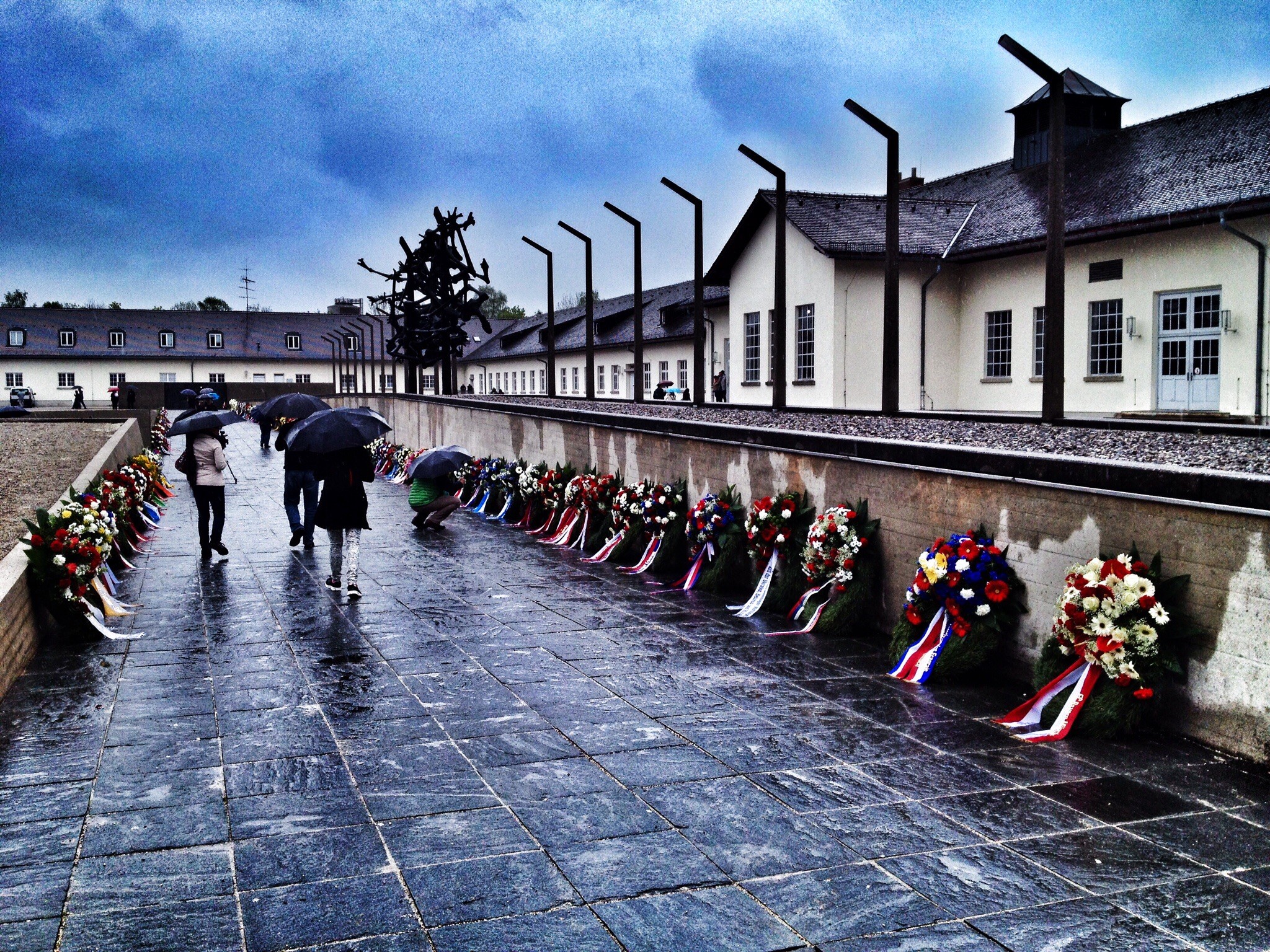
The atmosphere on this anniversary day was particularly solemn and powerful. The rainy weather just reinforced the overall mood. According to the memorial staff, 133 survivors attended the ceremony that year, though the number dwindles with each passing year.
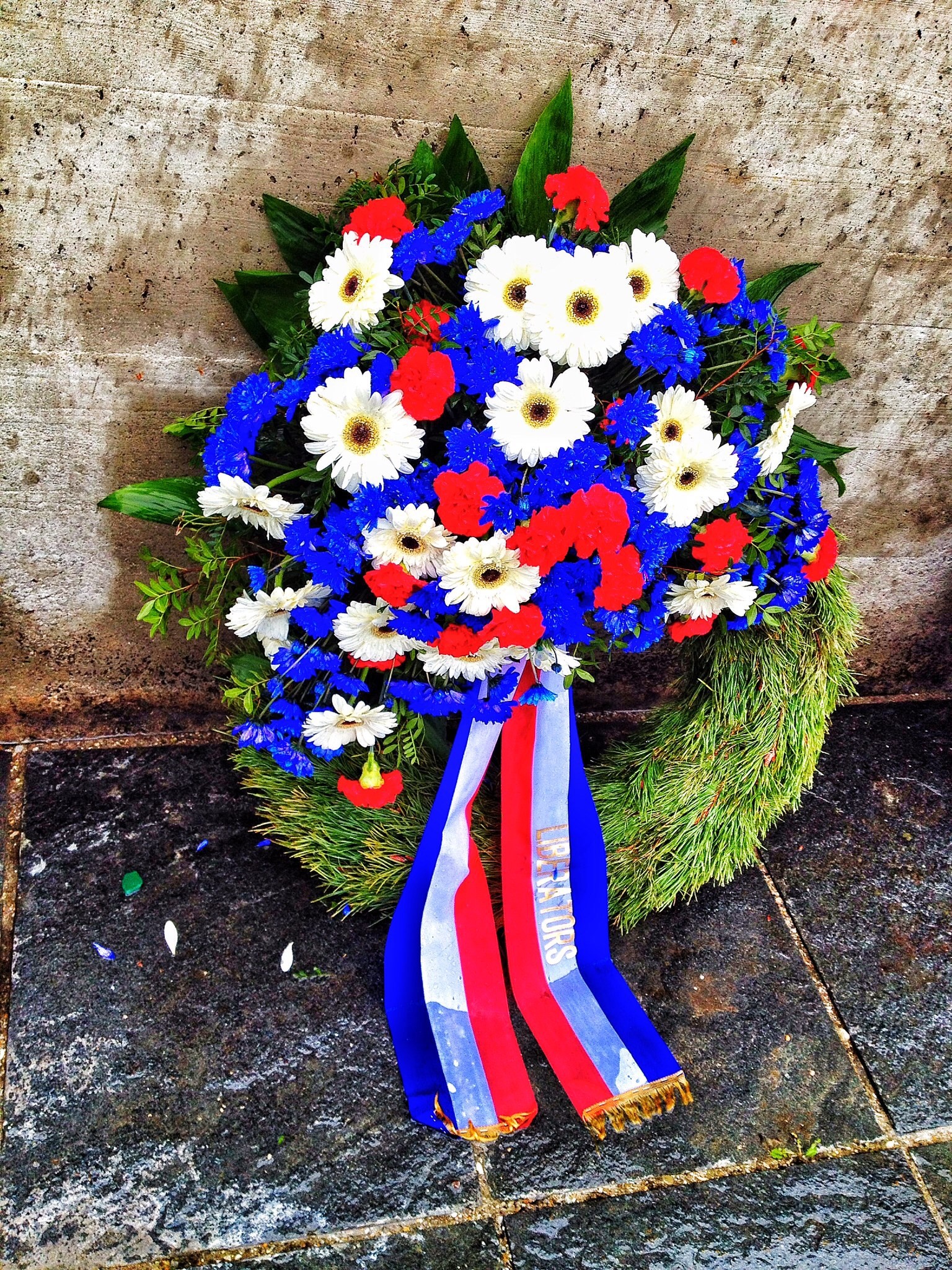
Throughout the memorial grounds, wreaths were placed by various groups and nations. The ones that moved me most were those labeled “Liberators”, representing the soldiers, like my grandfather, who opened the gates and freed the 32,000 surviving prisoners.
I arrived in the afternoon after the morning program had concluded and tours had resumed. My guide was exceptionally knowledgeable, walking our group through:
- Each building and its function
- The different categories of prisoners and the work they were forced to do
- The story of the one man who successfully escaped
- Countless other details that brought the camp’s horrific reality into focus
Confronting the Incomprehensible
Standing in the crematorium and seeing the gas chamber was the hardest part. There’s conflicting historical information about whether the gas chamber at Dachau was used for mass executions, but the reason for this is that this section of the camp had no survivors upon liberation. The uncertainty itself is haunting.
Walking through the museum, I saw some of the same photographs my grandfather had kept in his Ohio living room. Seeing them displayed as part of the historical record made my connection to this place visceral and real. These weren’t just images in a book. They were captured by someone who was there, someone I knew, someone who could barely speak about what he’d witnessed.
The scale of the operations is staggering. Morning and evening roll calls with 36,000 people standing in that enormous square? The systematic dehumanization, torture, medical experiments, and murder?
I went to Dachau hoping it would help me understand. In many ways, I left with a bigger mystery: How could human beings do this to other human beings?
The Strength of Survivors
What struck me most was the courage of the survivors who returned for the anniversary. The memorial staff member mentioned that 133 survivors were present that day. Men and women who had every reason never to set foot in this place again, yet they came back. They came back to remember those who didn’t survive and to ensure the world doesn’t forget.
I think often of my grandfather’s struggles with what he saw. (I was fortunate that he lived into his 90s.) And I’m in awe of the survivors who carry the memories of what they lived. They know a strength most of us will fortunately never have to know.
Frequently Asked Questions about Dachau
Explore More of Germany
Visiting Dachau Concentration Camp Memorial is not easy. It’s not fun. It’s not a typical tourist activity. But it’s important.
In a world where Holocaust denial still exists, where antisemitism is rising again, where new atrocities unfold, visiting places like Dachau becomes an act of defiance against forgetting. It’s a way of saying: this happened, these people mattered, we will not let this be erased from history.
For me, walking through Dachau connected me to my grandfather’s experience in a way I’d never felt before. I finally understood why he couldn’t talk about it. I finally grasped the weight he carried. And I felt the responsibility to carry forward the memory of those who suffered and died here.
As the last survivors and liberators pass away, we become the next generation to remember. We inherit their stories and the responsibility to never forget.
If you’re visiting Munich, make time for Dachau. Give it the hours it deserves. Listen to the stories. Remember. And perhaps most importantly: take that remembrance back into the world with you.
*all numbers represented were as given on our tour
Explore Further
- Where to Stay in Berlin: 6 Best Neighborhoods & Hotels
- How to Visit Dachau Concentration Camp Memorial from Munich
- What to Pack for a Christmas Market Trip to Europe
- Two Week European Christmas Market Itinerary: Central-Western Europe
- The Mugs of European Christmas Markets: How the Deposit Works
- How to Spend One Day in Lubeck, Germany
- 10 Key Tips for First-Time Visitors to European Christmas Markets
- Saxon Switzerland: Day Trip from Dresden, Germany
- 25 Tips for Visiting Berlin: Things to Know Before You Go
- 4 Day Itinerary for Berlin: How to Spend 4 Days in Berlin
Like this post? Pin it.